|
More
from and about
Thich Nhat Hanh
(biographical info at bottom of page) |
|
|
| |
|
Sometimes
your joy is the source of your smile,
but sometimes your smile can be the source of your joy. |
| |
|
People
usually consider walking on water or in thin air a miracle. But I
think the real miracle is not to walk either on water or in thin
air, but
to walk on earth. Every day we are engaged in a miracle which we
don't
even recognize: a blue sky, white clouds, green leaves, the black,
curious eyes of a child -- our own two eyes. All is a miracle.
When you plant
lettuce, if it does not grow well, you don't blame the
lettuce. You look for reasons it is not doing well. It
may need fertilizer, or more water, or less sun. You never
blame the lettuce. Yet if we have problems with our friends
or family, we blame the other person. But if we know how to
take care of them, they will grow well, like the lettuce.
Blaming has no positive effect at all, nor does trying to persuade
using reason and argument. That is my experience. No
blame, no reasoning, no argument, just understanding. If you
understand, and you show that you understand, you can love, and
the situation will change.
|

|
| |
|
I have noticed that people
are dealing too much with the
negative, with what is wrong. ... Why not try the other
way, to look into the patient and see positive things,
to just touch those things and make them bloom?
|
| |
|
Feelings,
whether of compassion or irritation, should be welcomed,
recognized, and treated on an absolutely equal basis;
because both
are ourselves. The tangerine I am eating is me. The mustard
greens
I am planting are me. I plant with all my heart and mind. I
clean this
teapot with the kind of attention I would have were I giving
the baby
Buddha or Jesus a bath. Nothing should be treated more
carefully than
anything else. In mindfulness, compassion, irritation,
mustard green
plant, and teapot are all sacred.
|
| |
|
When
you say something really unkind, when you do something in
retaliation
your anger increases. You make the other person suffer, and he
will try hard
to say or to do something back to get relief from his suffering.
That is how
conflict escalates.
|
|
| |
|
The past is gone, the future is not yet here,
and if we do not go back
to ourselves in the present moment, we cannot be in touch with
life. |
| |
|

|
|
quotations
- contents
-
welcome
page
- obstacles
- weblog
the
people behind the words
- our
current e-zine
- articles
and excerpts
Daily
Meditations, Year One - Year
Two - Year Three - Year
Four
Simple
and Profound website
Sign up for your free email daily
spiritual or general quotation
Sign
up for your free email daily meditation |
| |
|
Our
own life has to be our message. |
| |
|
The
source of love is deep in us and we can help others realize
a lot of happiness. One word, one action, one thought can reduce
another person’s suffering and bring that person joy. |
| |
|
Hope
is important because it can make the present moment less
difficult to bear. If we believe that tomorrow will be better,
we can bear a hardship today. |
| |
|

|
| |
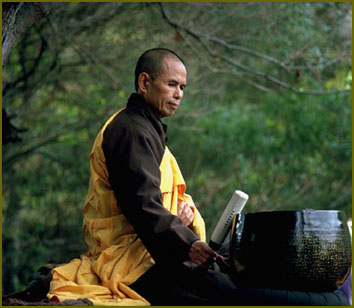
| Thich
Nhat Hanh (pronounced Tick-Naught-Han) is a Vietnamese Buddhist
monk. During the war in Vietnam, he worked tirelessly for
reconciliation between North and South Vietnam. His lifelong
efforts to generate peace moved Martin Luther King, Jr. to
nominate him for the Nobel Peace Prize in 1967. He lives in exile
in a small community in France where he teaches, writes, gardens,
and works to help refugees worldwide. He has conducted many
mindfulness retreats in Europe and North America helping veterans,
children, environmentalists, psychotherapists, artists and many
thousands of individuals seeking peace in their hearts, and in
their world.
Thich
Nhat Hanh has been living in exile from his native Vietnam since
the age of forty. In that year of 1966, he was banned by both the
non-Communist and Communist governments for his role in
undermining the violence he saw affecting his people. A Buddhist
monk since the age of sixteen, Thây ("teacher," as he
is commonly known to followers) earned a reputation as a respected
writer, scholar, and leader. He championed a movement known as
"engaged Buddhism," which intertwined traditional
meditative practices with active nonviolent civil disobedience.
This movement lay behind the establishment of the most influential
center of Buddhist studies in Saigon, the An Quang Pagoda. He also
set up relief organizations to rebuild destroyed villages,
instituted the School of Youth for Social Service (a Peace Corps
of sorts for Buddhist peace workers), founded a peace magazine,
and urged world leaders to use nonviolence as a tool. Although his
struggle for cooperation meant he had to relinquish a homeland, it
won him accolades around the world.
When
Thich Nhat Hanh left Vietnam, he embarked on a mission to spread
Buddhist thought around the globe. In 1966, when Thây came to the
United States for the first of many humanitarian visits, the
territory was not completely new to him: he had experienced
American culture before as a student at Princeton, and more
recently as a professor at Columbia. The Fellowship of
Reconciliation and Cornell invited Thây to speak on behalf of
Buddhist monks, and he offered an enlightened view on ways to end
the Vietnam conflict. He spoke on college campuses, met with
administration officials, and impressed social dignitaries. The
following year, Nobel Peace Prize winner Dr. Martin Luther King,
Jr., nominated Thich Nhat Hanh for the same honor. Hanh's Buddhist
delegation to the Paris peace talks resulted in accords between
North Vietnam and the United States, but his pacifist efforts did
not end with the war. He also helped organize rescue missions well
into the 1970's for Vietnamese trying to escape from political
oppression. Even after the political stabilization of Vietnam,
Thich Nhat Hanh has not been allowed to return home. The
government still sees him as a threat--ironic, when one considers
the subjects of his teachings: respect for life, generosity,
responsible sexual behavior, loving communication, and cultivation
of a healthful life style. |
| |
|
|
| |
|

|
We
have some
inspiring and motivational books that may interest you. Our main way of supporting this site is
through the sale of books, either physical copies
or digital copies for your Amazon Kindle (including the
online reader). All of the money that we earn
through them comes back to the site
in one way or another. Just click on the picture
to the left to visit our page of books, both fiction and
non-fiction! |
|
| |
|

|
|