|
More
from and about
Alan Watts
(biographical info lower on page) |
|
|
| |
|
When
you get free from certain fixed concepts of the way the
world is, you find it is far more subtle, and far more miraculous,
than you thought it was. |
| |
|
No
one imagines that a symphony is supposed to improve in
quality
as it goes along, or that the whole object of
playing it is to reach the finale. The point of music is
discovered in every moment of playing and listening to it. It is the same, I feel, with the greater part of our
lives,
and if we are unduly absorbed in improving them
we
may forget altogether to live them.
|

|
| |
|
Faith is a state of openness or trust. To have
faith is like when you trust
yourself to the water. You don't grab hold of the water when you
swim,
because if you do you will become stiff and tight in the water,
and sink.
You have to relax, and the attitude of faith is the very opposite
of clinging,
and holding on. In other words, a person who is fanatic in matters
of religion,
and clings to certain ideas about the nature of God and the
universe becomes
a person who has no faith at all. Instead they are holding tight.
But the attitude
of faith is to let go, and become open to truth, whatever it might
turn out to be.
|
| |
|
Tomorrow
and plans for tomorrow can have no significance at all
unless you are in full contact with the reality of the present,
since it is in the present and only in the present that you live.
There is no other reality than present reality, so that, even if
one were to live for endless ages, to live for the future
would be to miss the point everlastingly.
|
| |
|
We could
say that meditation doesn't have a reason or doesn't have
a
purpose. In this respect it's unlike almost all other things we do
except
perhaps making music
and dancing. When we make music we
don't do it in order to reach a
certain point,
such as the end of the
composition. If that were the purpose of
music then obviously
the fastest
players would be the best. Also, when we are dancing
we are not aiming
to arrive at a particular place on the floor as in a journey. When
we dance,
the
journey itself is the point, as when we play music the playing
itself
is the point. And exactly the same thing is true in meditation. Meditation
is
the discovery
that the point of life is always arrived at in the immediate
moment.
|
|
| |
|
Things
are as they are. Looking out into the universe at night,
we make no comparisons between right and wrong stars,
nor between well and badly arranged constellations. |
| |
|

|
|
welcome
page
- contents
-
gallery
-
obstacles
-
quotations
- the
people behind the words
our
current e-zine
-
articles
and excerpts
- Daily
Meditations, Year
Two - Year Three
Sign up
for your free daily spiritual or general quotation ~ ~ Sign
up for your free daily meditation |
| |
|
The only way to make sense out of change is to
plunge
into it, move with it, and join the dance. |
| |
|
The
art of living. . . is neither careless drifting on the one hand nor
fearful clinging to the past on the other. It consists in being
sensitive
to each moment, in regarding it as utterly new and unique,
in having the mind open and wholly receptive. |
| |
|
We
seldom realize, for example, that our most private thoughts and
emotions are not actually our own. For we think in terms of
languages
and images which we did not invent, but which were given to us by
our society. |
| |
|

|
| |
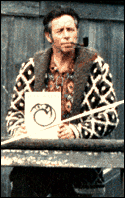
For
more than forty years, Alan Watts earned a reputation as a
foremost interpreter of Eastern philosophies for the West.
Beginning at
age sixteen, when he wrote essays for the journal of the Buddhist
Lodge
in London, he developed an audience of millions who were enriched
through his books, tape recordings, radio, television, and public
lectures. In all, Watts wrote more than twenty-five books and
recorded
hundreds of lectures and seminars, all building toward a personal
philosophy that he shared in complete candor and joy with his
readers
and listeners throughout the world. His overall works have
presented a
model of individuality and self-expression that can be matched by
few
philosophers.
His life and work reflects an astonishing adventure: he was an
editor, Anglican priest, graduate dean, broadcaster, author,
lecturer,
and entertainer. He had fascinations for archery, calligraphy,
cooking,
chanting, and dancing, and still was completely comfortable hiking
alone
in the wilderness.
He held a
Master's Degree in Theology from Sudbury-Western Theological
Seminary and an Honorary DD from the University of Vermont in
recognition of his work in the field of comparative religions.
He held fellowships from Harvard University and the Bollingen
Foundation, and was Episcopal Chaplain at Northwestern University
during the Second World War. He became professor and dean of the
American Academy of Asian Studies in San Francisco, made the
television series "Eastern Wisdom and Modern Life" for
National Educational Television, and served as a visiting
consultant for psychiatric institutions and hospitals, and for the
United States Air Force. In the mid-sixties he traveled widely
with his students in Japan, and visited Burma, Ceylon, and India.
|
| |
|
|
| |
|

|
We
have some
inspiring and motivational books that may interest you. Our main way of supporting this site is
through the sale of books, either physical copies
or digital copies for your Amazon Kindle (including the
online reader). All of the money that we earn
through them comes back to the site
in one way or another. Just click on the picture
to the left to visit our page of books, both fiction and
non-fiction! |
|
| |
|
|
|