|
More
from and about
Søren
Kierkegaard
(biographical info at bottom of page) |
|
|
| |
|
It
is perfectly true, as philosophers say, that life must be
understood
backwards. But they forget the other proposition, that it must be
lived forwards. |
| |
|
The
Bible is very easy to understand. But we Christians are a bunch
of scheming swindlers. We pretend to be unable to understand it
because we know very well that the minute we understand, we are
obliged to act accordingly.
|

|
| |
|
The greatest hazard of all,
losing one’s self, can
occur very quietly in the world, as if it were
nothing at all. No other loss can occur so quietly;
any other loss - an arm, a leg, five dollars, a wife,
etc. - is sure to be noticed.
|
| |
Love is the
expression of the one who loves, not of the one
who is loved. Those who think they can love only the people
they prefer do not love at all. Love discovers truths about
individuals that others cannot see.
If I were
to wish for anything, I should not wish for wealth and
power,
but for the passionate sense of the potential, for the eye
which, ever
young and ardent, sees the possible. Pleasure disappoints,
possibility
never. And what wine is so sparkling, what so fragrant, what
so
intoxicating, as possibility!
I have the
courage, I believe, to doubt everything; I have the courage,
I believe, to fight with everything; but I have not the
courage to know anything; not the courage to possess, to own
anything. Most people complain that the world is so prosaic,
that life is not like romance, where opportunities are
always so favorable. I complain that life is not like
romance, where one had hard-hearted parents and nixies and
trolls to fight, and enchanted princesses to free. What are
all such enemies taken together, compared with the pale,
bloodless, tenacious, nocturnal shapes with which I fight,
and to whom I give life and substance?
|
| |
|
A
fire broke out backstage in a theatre. The clown came out to warn
the public; they thought it was a joke and applauded. He repeated
it;
the acclaim was even greater. I think that's just how the world
will
come to an end: to general applause from wits who believe it's a
joke.
|
|
| |
|
God creates out of nothing. Wonderful you say.
Yes, to be sure,
but he does what is still more wonderful: he makes saints
out of sinners. |
| |
|

|
|
welcome
page
- contents
-
gallery
-
obstacles
-
quotations
- the
people behind the words
our
current e-zine
-
articles
and excerpts
- Daily
Meditations, Year
Two - Year Three
Sign up
for your free daily spiritual or general quotation ~ ~ Sign
up for your free daily meditation |
| |
|
Boredom
is the root of all evil--the despairing refusal to be oneself. |
| |
|
How
absurd people are! They never use the liberties they have,
they demand those they do not have. They have freedom
of thought, they demand freedom of speech. |
| |
|
Every
mental act is composed of doubt and belief,
but it is belief that is the positive, it is belief
that sustains thought and holds the world together. |
| |
|

|
| |
|
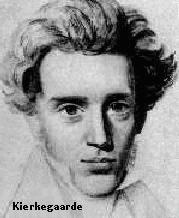
Søren
Aabye Kierkegaard (b.1813, d. 1855) was a profound and prolific
writer in the Danish "golden age" of intellectual and
artistic activity. His work crosses the boundaries of philosophy, theology,
psychology,
literary criticism, devotional literature and fiction.
Kierkegaard
brought this potent mixture of discourses to bear as social
critique and
for the purpose of renewing Christian faith within
Christendom. At the
same time he made many original conceptual contributions to each
of the disciplines he employed.
He is known as
the "father of existentialism," but at least as
important are his critiques of Hegel and of the German romantics,
his contributions to the development of modernism, his literary
experimentation, his vivid re-presentation of biblical figures to
bring out their modern relevance, his invention of key concepts
which have been explored and redeployed by thinkers ever since,
his interventions in contemporary Danish church politics, and his
fervent attempts to analyze and revitalize Christian faith.
Kierkegaard burned with the passion of a religious poet, was armed
with extraordinary dialectical talent, and drew on vast resources
of erudition.
|
| |
|
|
| |
|

|
We
have some
inspiring and motivational books that may interest you. Our main way of supporting this site is
through the sale of books, either physical copies
or digital copies for your Amazon Kindle (including the
online reader). All of the money that we earn
through them comes back to the site
in one way or another. Just click on the picture
to the left to visit our page of books, both fiction and
non-fiction! |
|
| |
|

|
|