|
prejudice
|
|
home - contents
- obstacles home
|
|
For
the most part, we tend to think of prejudice in terms of race,
culture, or religion, but the word has much deeper significance
than just the dislike of people with different skin colors or
religious practices than us. The term itself refers to a
"pre-judgment," or judging a person or culture or object
before
one knows anything about it on an individual level. It's a
judgment made with really no knowledge at all about the individual
or culture; thus, it's a judgment made in ignorance (another
strong obstacle to a full life).
Most people
who tend towards prejudiced judgments make their decisions based
on incomplete knowledge, or they generalize a great deal. A
person who is prejudiced against Asians because a young Asian man
insulted him two years ago is generalizing that one person's
actions to an entire group of people, thinking that all Asians are
the same as the one who insulted him. The African-American
who despises white people because his or her father was treated
poorly by whites are judging all people with white skin to be the
same as the people who hurt his or her parents. The
Christian who slanders Moslems because they don't believe the same
things that he or she does is judging those people based on his or
her own belief system, and is not looking at them as human beings
who have grown up with their own systems of belief.
There is no
doubt about it: prejudice is easy. Developing a
prejudiced perspective of the world makes virtually everything
black and white, with no room at all for shades of grey.
|
|
|
People are good or bad, and prejudiced people don't have to think
further or learn more about anyone--their minds are already made
up, and that's all there is to it. Prejudice in some ways is
a form of mental and emotional laziness, and in other ways it's a
huge barrier that people use to hide behind, trying to eliminate
threats to their feelings of safety and well being.
Prejudice
becomes dangerous when people try to get others to share it.
I may be prejudiced against people with green skin, but as long as
I keep that prejudice to myself it hurts no one but me. Once
I start to talk to my neighbor, though, and try to convince her
that all green-skinned people are bad, then I'm causing
harm. And when we start talking about what we should do
about the "problem" of green-skinned people, then we
become truly dangerous. In order to give ourselves
credibility, we distort reality, we stretch facts, and we ignore
the truth about the greenskins, just to make our case against them
stronger. At
its most basic, prejudice is our willingness to believe bad about
others without finding out the truth. And my prejudice
against greenskins means that I'm going to close myself off from
learning from them, I'm going to deprive myself of what they have
to share with me, and I'm going to live in fear of the greenskins
becoming stronger than me and doing something horrible to me to
pay me back for the way I feel about them. That's no way to
live a life, and by allowing my prejudices to control how I treat
others, I'm dooming myself to continued ignorance and future
fears. The
way to battle prejudice--in ourselves and in others--is
simple. We must educate ourselves as to the true nature of
all people. Individuals do not accurately represent any
racial, religious, or cultural group, and we're taking the easy
and lazy way out if we allow ourselves to define others by the
actions of very few.
|
|
| |
Those who are
possessed with a prejudice are possessed
with a devil, and one of the worst kinds of devils, for it
shuts out the truth, and often leads to ruinous error.
Tryon Edwards
|
| |
|
Prejudice
is the conjuror of imaginary wrongs, strangling truth,
over-powering reason, making strong people weak, and weak
people weaker. God gave us the large-hearted charity which
"beareth all things, believeth all things, hopeth all things,
endureth all things," which "thinketh no evil!"
John
Macduff
|
| |
|
|
|
quotations
- contents
-
welcome
page
-
obstacles
the
people behind the words
-
our
current e-zine
-
articles
and excerpts
Daily
Meditations, Year One - Year
Two - Year Three
- Year Four
Sign up
for your free daily spiritual or general quotation ~ ~ Sign
up for your free daily meditation
|
|
|
|

|
| |
|
Too
many of our prejudices are like pyramids upside down.
They rest on
tiny, trivial incidents, but they spread upward
and outward until they
fill our minds.
William
McChesney Martin |
| |
|
Prejudice can go very deep. It is only healed when
we end the war
within and accept those parts of ourselves
we find so unacceptable.
Then we will have the
courage to accept those who are different
from us, who
have different beliefs, who are a different color, or
who
live differently. When we can tolerate ourselves,
then we can
be tolerable toward others and extend kindness
to all equally.
Ed and Deb Shapiro |
| |
|
I was climbing
up a mountain-path
With many things to do,
Important business of my own,
And other people's too,
When I ran against a Prejudice
That quite cut off the view.
Charlotte Perkins Gilman
|
| |
|
|
| |
|
Prejudices
are the chains forged
by ignorance to keep people apart.
Countess
of Blessington
|
| |
|
Prejudices
are the refuge of those
who cannot think for themselves.
Comtesse
Diane |
| |
|
Most
people wish to be consoled, confirmed. They want
their prejudices reinforced and their structured belief
systems validated. After all, it hurts to think,
and it's absolute agony to think twice.
Jennifer
Stone
|
| |
|
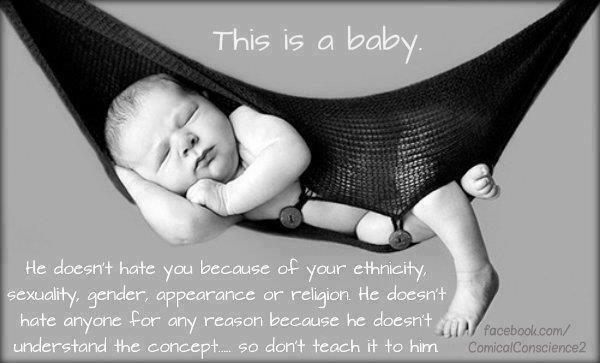
Just as a
child is born without fear,
so it is born
without prejudice. Prejudice, like fear, is acquired.
Marie
Killilea
|
| |
|
Prejudices,
it is well known, are most difficult to eradicate
from
the heart whose soil has never been loosened or
fertilized by
education; they grow there, firm as weeds among stones.
Charlotte Bronte
|
| |
|
Prejudice
is a seeping, dark stain, I think, more difficult to fight than
hatred--which is powerful and violent and somehow more honest.
Josephine
Lawrence
|
| |
|
Constantly
I am having to fight and overcome my prejudices because I
realize that first impressions and judgments are often misleading.
Harvey Day |
| |
|
|
| |
|
|
We
have some
inspiring and motivational books that may interest you. Our main way of supporting this site is
through the sale of books, either physical copies
or digital copies for your Amazon Kindle (including the
online reader). All of the money that we earn
through them comes back to the site
in one way or another. Just click on the picture
to the left to visit our page of books, both fiction and
non-fiction! |
|
| |
Ignorance and prejudice are the handmaidens of propaganda.
Our
mission, therefore, is to confront ignorance with knowledge, bigotry
with tolerance, and isolation with the outstretched hand of generosity.
Racism can, will, and must be defeated.
Kofi Annan |
| |
|
The fact
that we are human beings is infinitely more important than all
the peculiarities that distinguish human beings from one another.
Simone de Beauvoir |
| |
|
Prejudice
does not think logically. It does not ask why, and remains
on the deceptive surface. The mark of the sage is the lack of
prejudice,
that of a fool, the lack of thought.
Hans-Ulrich Rieker |
| |
|
quotations
- contents
-
welcome
page
-
obstacles
the
people behind the words
-
our
current e-zine
-
articles
and excerpts
Daily
Meditations, Year One - Year
Two - Year Three
- Year Four
Sign up
for your free daily spiritual or general quotation ~ ~ Sign
up for your free daily meditation
|
| |
|
What does
the color of one's skin tell us that is of any significance
about a person? Nothing, of course, absolutely nothing. It
does
not say whether the person is warmhearted or kind,
clever or witty, or whether that person is good.
Desmond Tutu |
| |
|
Unless
we empty ourselves of preconceived cultural or intellectual images
and expectations, we not only cannot understand the Other, we
cannot even listen. Indeed, we cannot even feel empathy.
M. Scott Peck
The Different Drum
|
| |
|
Until
justice is blind to color, until education is unaware of race, until
opportunity is unconcerned with the color of people's skin,
emancipation will be a proclamation but not a fact.
Lyndon B. Johnson |
| |
|

|
|