|
More
from and about
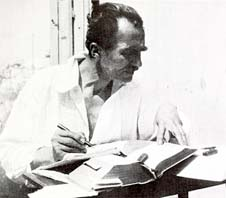
Nikos Kazantzakis
(biographical info at bottom of page) |
|
|
| |
|
How simple and
frugal a thing is happiness: a glass of wine,
a roast chestnut,
a wretched little brazier, the sound of the sea. . . .
All that
is required to feel that here and now is happiness,
is a simple,
frugal heart. |
| |
|
This
is true happiness: to have no ambition and to work like a horse
as if you had every ambition. To live far from men, not to need
them
and yet to love them. To have the stars above, the land to your
left
and the sea to your right and to realize of a sudden that in your
heart,
life has accomplished its final miracle: it has become a fairy
tale.
Once more I realized
to what an extent earthly happiness is made to the measure of man.
It is not a rare bird which we must pursue at one moment in
heaven, at the next in our minds. Happiness is a domestic bird
found in our own courtyards.
|
|
| |
|
True teachers are those who
use themselves as bridges over which they invite their students to cross; then,
having facilitated their crossing, joyfully collapse,
encouraging them to create their own.
|
| |
When
everything goes wrong, what a joy to test your soul and
see if it has endurance and courage! An invisible and
all-powerful
enemy— some call him God, others the Devil, seem to rush
upon
us to destroy us; but we are not destroyed.
What first
truly stirred my soul was not fear or pain, nor was it
pleasure or games; it was the yearning for freedom. I had to
gain freedom - but from what, from whom? Little by little,
in the course of time, I mounted freedom's rough
unaccommodating ascent. To gain freedom first of all from
the Turk, that was the initial step; after that, later, this
new struggle began: to gain freedom from the inner Turk--from
ignorance, malice and envy, from fear and laziness, from
dazzling false ideas; and finally from idols, all of them,
even the most revered and beloved.
|
| |
|
I
was happy, I knew that. While experiencing happiness, we have
difficulty
in being conscious of it. Only when the happiness is past and we
look back
on it do we suddenly realize--sometimes with astonishment--how happy we had been.
|
|
| |
|
Beauty is merciless. You do not look at it;
it looks at you and does not forgive. |
| |
|
|
|
welcome
page
- contents
-
gallery
-
obstacles
-
quotations
- the
people behind the words
our
current e-zine
-
articles
and excerpts
- Daily
Meditations, Year
Two - Year Three
Sign up
for your free daily spiritual or general quotation ~ ~ Sign
up for your free daily meditation |
| |
|
Let
your youth have free reign, it won't come again, so be bold and no
repenting. |
| |
|
When
an almond tree became covered with blossoms in the heart
of winter, all the trees around it began to jeer. "What
vanity,"
they screamed, "what insolence! Just think, it believes it
can bring
spring in this way!" The flowers of the almond tree
blushed for
shame. "Forgive me, my sisters," said the tree. "I
swear I did not want
to blossom, but suddenly I felt a warm springtime breeze in my
heart.” |
| |
|
Discipline
is the highest of all virtues. Only so may strength and
desire be counterbalanced and the endeavors of people bear fruit. |
| |
|

|
| |
One
of the most important Greek writers, poets and philosophers of the
20th century, Kazantzakis was born in Iraklion in 1883. In
1906 he graduated from the Athens Law School and continued his
studies in Paris. During the Balkan Wars he fought as a
volunteer in the Greek Army. After the Wars he traveled to
many European and Asian countries, publishing travelogues from his
trips (Spain, Egypt-Sinai, China-Japan, Russia, England, etc.).
Kazantzakis, much more of a philosopher than a writer, was deeply
influenced by the writings of Nietzsche and Bergson, and the
philosophies of Christianity, Marxism and Buddhism. In his
work, he attempted to synthesize these different world views.
In 1927 he
published the book "Askitiki", the main work of his
philosophy. In 1938, after constantly revising it for 13
years, he publishes his epic poet Odyssey: A modern sequel,
continuing Ulysses' story from the point where Homer leaves
off. This huge poetical work is comprised of 33,333 verses.
He became famous, however, during the last years of his life, when
he turned to writing novels. During that time he published,
among others, Zorba the Greek, The Last Temptation of
Christ, Freedom and Death, The Greek Passion, and
his autobiography Report to Greco (Anafora ston Greco).
The Last Temptation of Christ was considered quite
controversial when first published in 1955, and prompted angry
reactions from both the Roman Catholic Church which banned it, and
from the Greek Orthodox Church which tried to excommunicate him!
On the 28th of June, 1956, in Vienna, he was awarded the
International Peace Award. He died in 1957 in Germany and is
buried on one of the bastions of the Venetian fort surrounding
Iraklion, Martinego. In the Historical Museum of Crete there
is a room devoted to Nikos Kazantzakis. His desk, library, some of
his personal belongings as well as manuscripts of many of his
works are displayed. A complete picture of Nikos Kazantzakis
life and work can also be acquired by a visit to the Nikos
Kazantzakis Museum in Myrtia.
To honor the 40th
anniversary of his death, a whole range of cultural events were
scheduled in Greece and abroad for 1997.
|
| |
|
|
| |
|

|
We
have some
inspiring and motivational books that may interest you. Our main way of supporting this site is
through the sale of books, either physical copies
or digital copies for your Amazon Kindle (including the
online reader). All of the money that we earn
through them comes back to the site
in one way or another. Just click on the picture
to the left to visit our page of books, both fiction and
non-fiction! |
|
| |
|

|
|