|
More
from and about
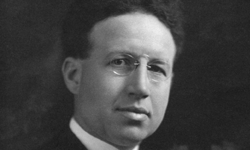
Harry Emerson Fosdick
(biographical info at bottom of page) |
|
|
| |
|
The
world is moving so fast these days that the man who says
it can't be done is generally interrupted by someone doing it. |
| |
|
Those
who know no hardships will know no hardihood. Those who face no
calamity will need no courage. Mysterious though it is, the
characteristics in human nature
which we love best grow in a soil with
a strong mixture of troubles.
The most
extraordinary thing about the oyster is this. Irritation gets into
his shell. He does not like them. But when he cannot get rid of
them he uses the irritation to do the lovelist thing an oyster
ever has the chance to do. If there are irritations in our lives
today, there is only one prescription: make a pearl. It may
have to be a pearl of patience, but make a pearl.
|

|
| |
|
People will work hard for money.
They will work harder for
other people. But people will work hardest of all when they
are dedicated to a cause. Until willingness overflows
obligation, people fight as conscripts rather than following
the flag as patriots. Duty is never worthily performed
until it is performed by one who would gladly do more
if only he or she could.
|
| |
Rebellion
against your handicaps gets you nowhere. Self-pity
gets you nowhere. One must have the adventurous daring to
accept oneself as a bundle of possibilities and undertake
the
most interesting game in the world — making the most of
one’s best.
No horse gets
anywhere until he is harnessed. No stream or gas drives
anything until it is confined. No Niagara is ever
turned into light and power until it is tunneled. No
life ever grows great until it is focused, dedicated,
disciplined. One of the widest gaps in human
experience is the gap between what we say we want to be and
our willingness to discipline ourselves to get there.
|
| |
|
Whatever
the situation and however disheartening it may be, it is a great
hour when a person ceases adopting difficulties as an excuse for
despondency and tackles him- or herself as the real problem.
No mood
need be our master.
|
|
| |
|
I'd rather live in a world where my life is
surrounded by mystery than
live in a world so small that my mind could comprehend it. |
| |
|

|
|
welcome
page
- contents
-
gallery
-
obstacles
-
quotations
- the
people behind the words
our
current e-zine
-
articles
and excerpts
- Daily
Meditations, Year
Two - Year Three
Sign up
for your free daily spiritual or general quotation ~ ~ Sign
up for your free daily meditation |
| |
|
Democracy is based upon the
conviction that there
are extraordinary possibilities in ordinary people. |
| |
|
Picture
yourself vividly as winning and that alone will contribute
immeasurably to success. Great living starts with a picture, held
in your imagination, of what you would like to do or be. |
| |
|
Peace
is an awareness of reserves from beyond ourselves, so that
our power is not so much in us as through us. Peace is the gift,
not
of volitional struggle, but of spiritual hospitality. |
| |
|

|
| |
Harry
Emerson Fosdick (1879-1969) American clergyman, b. Buffalo, N.Y.,
graduated from Colgate University, 1900, and Union Theological
Seminary, 1904. Ordained a Baptist minister in 1903.
Fosdick was the most prominent liberal baptist minister of the
early 20th Century. He was Pastor of the First Presbyterian
Church on West Twelfth Street and then at historic Riverside
Church (formerly Park Avenue Baptist Church) in New York City.
Fosdick became a central figure in the conflict between
fundamentalist
and liberal forces within American Protestantism in the 1920s and
1930s. While at First Presbyterian Church, on May 12, 1922, he delivered
his
famous sermon "Shall the Fundamentalists Win?" in which
he defended
the modernist position. In that sermon he presented the
Bible as
record of the unfolding of God's will, not as the literal Word of
God. He saw the history of Christianity as one of development,
progress, and
gradual change. To the fundamentalists, this was rank apostasy,
and the battle lines were drawn.
Dr. Fosdick was an outspoken opponent of racism and injustice.
Fosdick
also supported appeasement of Hitler and argued "moral
equivalence",
i.e. that the democracies were largely to blame for the rise of
fascism: "the all but unanimous judgment seems to be
that we, the democracies,
are just as responsible for the rise of the dictators as the
dictatorships themselves, and perhaps more so."
Fosdick's sermons won him wide recognition, as did his radio
addresses
which were nationally broadcast. He authored numerous books, and
many of his sermon collections are still in print. He is also the
author of the hymn, "God of Grace and God of Glory".
Fosdick had a daughter Dorothy Fosdick who was foreign policy
adviser
to Henry M. Jackson.
|
| |
|
|
| |
|

|
We
have some
inspiring and motivational books that may interest you. Our main way of supporting this site is
through the sale of books, either physical copies
or digital copies for your Amazon Kindle (including the
online reader). All of the money that we earn
through them comes back to the site
in one way or another. Just click on the picture
to the left to visit our page of books, both fiction and
non-fiction! |
|
| |
|

|
|