|
More
from and about
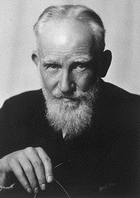
George Bernard Shaw
(biographical info at bottom of page) |
|
|
| |
|
Happiness is a perfume you cannot pour on others
without getting a few drops on yourself. |
| |
|
People
are always blaming their circumstances for what they are. I don't believe in circumstances. The people who get on in this
world
are the people who get up and look for the circumstances they
want,
and if they can't find them, make them.
A
day's work is a day's work, neither more nor less,
and the one who does
it needs a day's sustenance,
a night's repose and due leisure,
whether
he or she be a painter or a ploughman.
|

|
| |
|
This is the true joy in life,
the being used for a purpose
recognized by yourself as a mighty one; the being thoroughly
worn out before you are thrown on the scrap heap; the being
a force of Nature instead of a feverish selfish little clod
of ailments and grievances complaining that the world will
not devote itself to making you happy.
|
| |
Life is no
brief candle to me. It is a sort of splendid torch which I
have
got a hold of for the moment, and I want to make it burn as
brightly
as possible before handing it on to future generations.
We
don't stop playing because we grow old; we grow old because
we stop playing.
|
| |
|
The
secret of being miserable is to have leisure to bother about
whether
you are happy or not. The cure for it is occupation, because
occupation
means pre-occupation; and the pre-occupied person is neither happy
nor
unhappy, but simply alive and active. That is why it is necessary
to
happiness that one should be tired.
|
|
| |
|
A life spent making mistakes is not only more
honorable,
but more useful than a life spent doing nothing. |
| |
|

|
|
welcome
page
- contents
-
gallery
-
obstacles
-
quotations
- the
people behind the words
our
current e-zine
-
articles
and excerpts
- Daily
Meditations, Year
Two - Year Three
Sign up
for your free daily spiritual or general quotation ~ ~ Sign
up for your free daily meditation |
| |
|
The
most tragic thing in the world is a person of genius who is not a
person of honor. |
| |
|
That
is the injustice of a woman's lot. A woman has to bring up
her children; and that means to restrain them, to deny them
things they want, to set them tasks, to punish them when they
do wrong, to do all the unpleasant things. And then the father,
who has nothing to do but pet them and spoil them, comes in
when all her work is done and steals their affection from her. |
| |
|
You
are going to let the fear of poverty govern your life and
your reward will be that you will eat, but you will not live. |
| |
|

|
| |
George
Bernard Shaw (1856-1950) was born in Dublin, the son of a civil
servant. His education was irregular, due to his dislike of any
organized training. After working in an estate agent's office for
a while he moved to London as a young man (1876), where he
established himself as a leading music and theatre critic in the
eighties and nineties and became a prominent member of the Fabian
Society, for which he composed many pamphlets. He began his
literary career as a novelist; as a fervent advocate of the new
theatre of Ibsen (The Quintessence of Ibsenism, 1891) he
decided to write plays in order to illustrate his criticism of the
English stage. His earliest dramas were called appropriately Plays
Pleasant and Unpleasant (1898). Among these, Widower's
Houses and Mrs. Warren's Profession savagely attack
social hypocrisy, while in plays such as Arms and the Man
and The Man of Destiny the criticism is less fierce. Shaw's
radical rationalism, his utter disregard of conventions, his keen
dialectic interest and verbal wit often turn the stage into a
forum of ideas, and nowhere more openly than in the famous
discourses on the Life Force, "Don Juan in Hell", the third act
of the dramatization of woman's love chase of man, Man and
Superman (1903).
In the plays of his later period discussion sometimes drowns the
drama, in Back to Methuselah (1921), although in the same
period he worked on his masterpiece Saint Joan (1923), in
which he rewrites the well-known story of the French maiden and
extends it from the Middle Ages to the present.
Other important plays by Shaw are Caesar and Cleopatra
(1901), a historical play filled with allusions to modern times,
and Androcles and the Lion (1912), in which he exercised a
kind of retrospective history and from modern movements drew
deductions for the Christian era. In Major Barbara (1905),
one of Shaw's most successful «discussion» plays, the audience's
attention is held by the power of the witty argumentation that man
can achieve aesthetic salvation only through political activity,
not as an individual. The Doctor's Dilemma (1906),
facetiously classified as a tragedy by Shaw, is really a comedy
the humor of which is directed at the medical profession. Candida
(1898), with social attitudes toward sex relations as objects of
his satire, and Pygmalion (1912), a witty study of
phonetics as well as a clever treatment of middle-class morality
and class distinction, proved some of Shaw's greatest successes on
the stage. It is a combination of the dramatic, the comic, and the
social corrective that gives Shaw's comedies their special flavor.
Shaw's complete works appeared in thirty-six volumes between 1930
and 1950, the year of his death.
|
| |
|
|
| |
|

|
We
have some
inspiring and motivational books that may interest you. Our main way of supporting this site is
through the sale of books, either physical copies
or digital copies for your Amazon Kindle (including the
online reader). All of the money that we earn
through them comes back to the site
in one way or another. Just click on the picture
to the left to visit our page of books, both fiction and
non-fiction! |
|
| |
|

|
|