|
comparison
|
|
home
- contents - obstacles
contents
|
| |
One
of the most important lessons I ever learned about
comparing ourselves to others came from a student in one
of my writing classes. My classes include a
peer-editing element, during which students read each
other's papers and give them feedback. Near the end
of the semester, I was having a conference with one of the
students who was easily the second-best writer in the
class. Her work was clear and well structured and
showed very few mechanical errors. I'll call her
Kim, which isn't her real name.
At
our conference, Kim mentioned that she felt bad about her
writing because from reading other students' papers during
the peer editing process, she got the idea that her
writing was not very good at all. I was taken aback
for a moment, and then I realized the problem. Kim
sat next to the best writer in the class, who wrote
extremely well developed papers with almost no errors at
all. When it came time to do peer editing, Kim
always traded with this other young woman first, so the
first thing she always read was a paper by someone who had
a writing ability far beyond her years. Because of
this, Kim saw herself as a less-than-adequate writer even
though she was, in fact, a far-above-average writer.
It was her choice to see herself this way, though, because
she also read papers by students who weren't nearly as
gifted at writing as she was; she chose to compare herself
to the gifted writer, though, and she came out sub-par in
her own eyes.
|

|
|
Such
comparisons can have positive sides--if Kim decided that
she was going to work even harder to become an even better
writer because she wanted to reach the other student's
level, then that comparison would have provided her with
motivation. Athletes constantly compare their times
or performances with those of other athletes so that
they'll be motivated to work harder and improve. One
thing that you'll rarely see with athletes, though, is for
them to give up and never compete again just because
someone else is better at their event than they are.
They know that improvement in athletics comes when we
compete against ourselves, when we're able to be objective
about our performances and work to improve them.
When
we compare our own skills or abilities to those of other
people, we're doing ourselves a great disservice.
We're often setting a standard for ourselves that is far
too high, depending on the area of comparison. My
brother may be much stronger than I, and I could give up
athletics in discouragement because I'll never do as well
in some things as he does. On the other hand, I can
run much faster and longer than he can, so why do I spend
so much time focusing on the comparison that puts me in a
bad light?
It's
not a ridiculous analogy--I've known hundreds of people in
my life who criticize themselves for not being as good as
someone else at something. And when I've pointed out
that they have their own strengths, the usual answer is
something like, "Yeah, but. . . ."
Somehow, they want to stay focused on the area that
makes them look bad. Perhaps it makes life easier
when we see ourselves as poor performers in certain areas,
because then we never have to deal with high
expectations. And they want to avoid focusing on
their strengths, because doing so just might make them
feel good about themselves.
It's
a very treacherous tendency.
I
wish I could tell all my students and all the people they
know that they should focus on their strengths. I've
taken piano lessons and I've spent many, many hours
practicing the guitar, and I'm still nothing better than a
poor-to-mediocre player. I decided early on to
relegate those endeavors to hobbies, because it was
obvious that I never would get that good because of my
poor hand-eye coordination where music is concerned.
I had friends in bands, and I would have liked nothing
more than to be able to play in a band, but that just
wasn't possible. Rather than get down on myself for
not being as good as my friends, though, I focused on the
things I did well--writing and running and drawing, for
example, and felt pretty good about what I did in those
areas.
In
our school systems, though, we set people up for this
tendency when we make everyone take the same classes, and
then we give them grades to let them know how their
performance compares to the performances of others.
Kids learn early on to compare themselves to classmates'
grades, to brothers' and sisters' performance in
school. "Your sister got all A's; how come you
got C's?" "I got an A on the quiz--what
did you get?" It's a sad system that we have to
get over in our minds if we're to make the most of the
gifts that we do have, the strengths that are uniquely
ours.
If
you're going to compare yourself to motivate yourself,
then by all means do so. Use another person's
performance to improve yours. But if you're going to
judge yourself and make yourself feel awful because
someone else is better at something than you, then please
remember this: you're choosing to make yourself
miserable by choosing what to focus on, and by choosing
the meaning that you assign to it. Kim saw the other
student's writing as meaning that Kim wasn't a good
writer. The truth of the matter was far from that.
|
|
| |
|
Instead of comparing our lot with that of those
who are more
fortunate than we are, we should compare it with the
lot
of the great majority of our fellow humans.
It then appears
that we are among the privileged.
Helen Keller
|
| |
|

|
|
quotations
- contents
-
welcome
page
-
obstacles
the
people behind the words
-
our
current e-zine
-
articles
and excerpts
Daily
Meditations, Year One - Year
Two - Year Three
- Year Four
Sign up
for your free daily spiritual or general quotation ~ ~ Sign
up for your free daily meditation
|
|
|
|

|
| |
Comparison, more than reality, makes people happy
or wretched.
Thomas Fuller |
| |
|
The thing
about comparison is that there is never a win. How
often do we compare ourselves with someone less fortunate
than us and consider ourselves blessed? More often, we compare
ourselves with someone who we perceive as being, having or
doing more. And this just leaves us coming up short.
Sonya Derian |
| |
|
Resist
the temptation to compare yourself to others in a negative
fashion. . . .
If you are in the midst of making such
comparisons--stop! It is human nature
to do some comparing, and when we are in a
good spot and feeling pretty good
about ourselves, it can even be
positive, as it may inspire us to emulate
someone else. But
when
we are wrestling with self-acceptance, comparing
ourselves to
others is one of the worst things we can do. It is
tantamount to
scolding a child who falls off his or her bike for lacking the
skills
of a professional
bicyclist. We wouldn't think of doing
that,
but when we compare ourselves to
others, with us on the
bottom and virtually everyone else above us and better
than us, we are hurting ourselves just as heartlessly.
Gary
Egeberg
|
| |
|
Many
of our feelings of satisfaction or dissatisfaction have
their roots in how we compare ourselves to others.
When we compare ourselves to those who have more, we feel
bad. When we compare ourselves to those who have
less, we feel grateful. Even though the truth is we
have exactly the same life either way, our feelings about
our life can vary tremendously based on who we compare
ourselves with. Compare yourself with those examples
that are meaningful but that make you feel comfortable
with who you are and what you have.
David
Niven
|

|
|
| |
|
|
| |
|
Why
compare yourself with others? No one in the entire world
can do a better job of being you than you.
unattributed
|
| |
|
|
| |
Personality
begins where comparison leaves off. Be unique.
Be memorable. Be confident. Be proud.
Shannon L. Alder |
| |
|
Don't
always be appraising yourself, wondering if you are better or
worse than other writers. "I will not Reason and
Compare," said Blake;
"my business is to Create." Besides, since you are
like no other being
ever created since the beginning of Time, you are incomparable.
Brenda Ueland
If You Want to Write |
| |
|
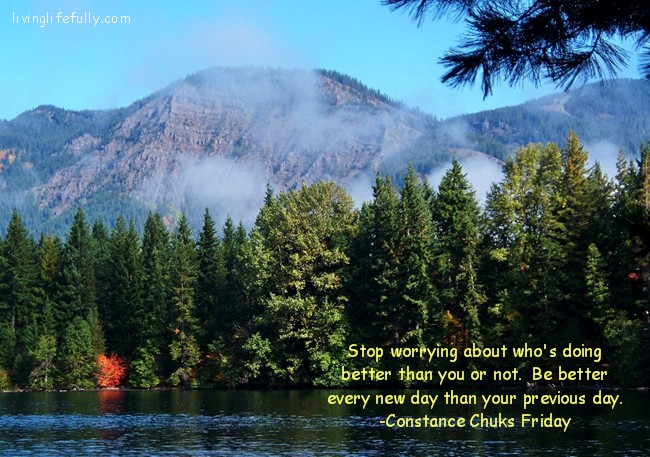
Stop worrying about who's doing better than you
or not.
Be
better every new day than your previous day.
Constance Chuks Friday |
| |
|
|
| |
|
|
| |
|
Don't
undermine your worth by comparing yourself with
others.
It is
because we are different that each of
us is special.
Brian Dyson
|
| |
|
Recently
my fingers have developed a prejudice against comparatives.
They all follow this pattern: a squirrel is smaller than a
tree; a bird is
more musical than a tree. Each of us is the strongest one in
his or her
own skin. Characteristics should take off their hats to one
another,
instead of spitting in each other's faces.
Berthold Brecht
|
| |
|
When you are
content to be simply yourself and don't
compare or compete, everybody will respect you.
Lao Tzu |
| |
|
If you
compare yourself with others, you may become vain and bitter,
for always there will be greater and lesser persons than yourself.
Max Ehrmann |
| |
|
Do
not compare yourself
with others, for you are
a unique and wonderful creation.
Make your own beautiful
footprints
in the snow.
Barbara
Kimball |
| |
I cannot say
this too strongly: Do not compare yourselves to others.
Be true to who you are, and continue to learn with all your might.
Daisaku Ikeda
Discussions on Youth |
| |
|
How much
time that person gains who does not look to see what his
or her neighbor says or does or thinks, but only at what
one does oneself, to make it just and holy.
Marcus Aurelius
Meditations |
| |
|
Do not compare
yourself with anybody. Compare yourself with
yourself, for
yourself and by yourself. We are all uniquely
pottered and
purposed by our creator!
Ifeanyi Enoch Onuoha |
| |
|
|
|
quotations
- contents
-
welcome
page
-
obstacles
the
people behind the words
-
our
current e-zine
-
articles
and excerpts
Daily
Meditations, Year One - Year
Two - Year Three
- Year Four
Sign up
for your free daily spiritual or general quotation ~ ~ Sign
up for your free daily meditation
|
| |
Comparison is
the enemy to creativity.
E'yen A. Gardner |
| |
|
Never
judge your strength by comparison, because there is always going
to be someone who is more experienced than you. Judge by
your
dedication to what you do, and your ability to make
progress. And even
if there is someone better than you, use that as motivation, and
strive
to become better, because that's what they did.
Aaron DeCamp |
| |
|

|
|
|