desire
|
|
home
- contents - obstacles
contents
|
| |
If
it weren't for desire, most of the positive things that
we have in the world wouldn't exist, most of the positive
actions we experience and benefit from wouldn't have
occurred, and most of our positive resources just wouldn't
be. Desire is extremely important in life, for it allows
us, compels us to work towards something better for
ourselves and others. If I desire a better life for
myself and my family, I'm going to work towards that
better life. If I'm satisfied with the status quo, I'm
going to remain rather passive, not looking to accomplish
much, not looking to advance.
Of course, desire has its dark
side, especially when it degenerates into covetousness or
envy. These traits (for lack of a better word) are
extremely destructive, and they definitely hold one back
from getting the most out of life. But another dark side
of desire has to do with the objects of our desire, and
literature is full of examples of characters who have
desired the wrong thing and ended up hurting themselves
and others because they've focused so strongly on their
own desires and on achieving those desires.
An
extremely good example of this occurs in the film Dead
Poets Society. In this film, one
character's father desires one thing of his son: that he
go on to medical school and become a doctor. Because he's
so focused on having this desire become reality, he
completely disregards his son's desires for his own life,
and his son ends up killing himself because he sees no
hope for a future that he desires.
|
|
|
But it goes further than that.
The father's desire obviously isn't just
that his son become a doctor. The father also desires to
be proud of his son, but on his own
terms. The father also desires the approval of his peers
and colleagues--he wants his son to be a doctor so that
these people will look favorably upon him, the father,
and the great job he's done raising his son to enter such
a noble (and lucrative) profession. He also desires to be
in control, and seeing his son do things that he hasn't
sanctioned, such as act in a play or be on the yearbook
staff, takes away much of that control, and he can't
stand the idea of losing it.
People
also have problems when they desire things that are
inaccessible. Advertising plays a large part in this
problem, for advertising exists to a large extent to
create desire in an audience. The person who desires a
new BMW but who makes $25,000 a year, often finds the
beauty of life somehow diminished due to the lack of a
particular car in his or her life (and yes, I have known
such people). A major problem arises when that person
goes ahead and buys the car even though he or she can't
afford it--life is now full of money problems that just
weren't there before the purchase. The desire for an
object has added stress and strain to a life, and to the
lives of that person's family members.
I married very late, and for a
very long time, I desired nothing more than to be married. Because of this desire, I often approached relationships
in a very forced way, a very unsure way. I hardly allowed
myself to be myself, always trying to fit some role, even
though I was trying to be myself. It wasn't until I let
go of the desire to be married and forced myself to deal
with every new woman that I met as a potential friend,
not a potential wife, that I was able to act much more
naturally. It wasn't long after I had made that shift in
my thinking that I met my wife, and we were married a
year later. My desire for marriage was natural, but
because I had allowed it to be so strong and to control
my actions, it affected the way I treated people, and
thus affected me in a very negative way.
There's
nothing wrong with desire; in fact, it's inherently
wonderful. Desire causes us to work harder to achieve
goals. But we must be sure that the objects of our desire
are attainable, and if they're not, then we must admit
that to ourselves. Sometimes those things that we desire
are the things that turn out to be the most harmful to us
and others. If you desire something unattainable or
inappropriate, admit that desire to yourself, but also
acknowledge that acting to fulfill that desire would be
very inappropriate and harmful. If you desire something
appropriate and attainable, go for it--and good luck in
getting it.
|
|
| |
|
Welcome everything that comes to you,
but do not long for anything else.
Andre Gide |
| |
|

|
|
quotations
- contents
-
welcome
page
-
obstacles
the
people behind the words
-
our
current e-zine
-
articles
and excerpts
Daily
Meditations, Year One - Year
Two - Year Three
- Year Four
Sign up
for your free daily spiritual or general quotation ~ ~ Sign
up for your free daily meditation
|
|
|
|

|
| |
|
We don't need to
increase our goods nearly as much
as we need to scale down our
wants.
Not wanting something is as good as possessing it.
Donald Horban |
| |
|
Moderate desires
constitute a character fitted to acquire all the good which
the world
can yield. Those who have this character are prepared, in whatever
situation they are, therewith to be content and have learned the science
of being happy.
Timothy Dwight
|
| |
|
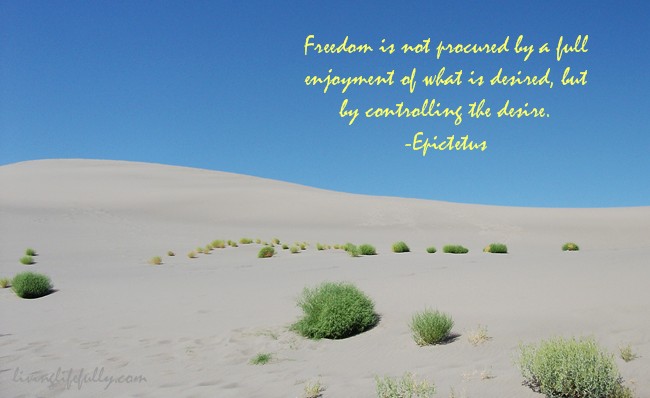
Freedom
is not procured by a full enjoyment of what is desired,
but by controlling the desire.
Epictetus |
| |
|
Each
desire. . . causes us to act and think in ways that result in
yet even more desires and cravings. Like a dog running
after its own tail, cause and effect chase each other around
in circles. "But," you may be asking,
"don't we need to desire things?"
It is
certainly true that not all desires are equal in terms of how
they create suffering. Some desires, of course, are
simply a matter of preference that might not really make much
of a difference. Wanting to paint your house pink
instead of brown will not harm anyone--except maybe the
fashion police.
And yes,
there definitely are many good desires. For example,
without the desire for food we would not stay alive. It
is when our desire becomes an unquenchable craving or
obsession, or causes us to do harm to ourselves or others,
that it creates suffering and unhappiness. If you have
ever been hurt because you tied your happiness or well-being
to a person, place, opinion, self-identity, behavior, or goal,
then you have firsthand experience of desire.
Donald
Altman
|
|
| |
|
|
| |
|
One
who knows that enough is enough will always have enough.
Lao-Tzu
|
| |
|
When one withdraws all
desires
as a tortoise withdraws its limbs,
the natural splendor of
the world soon manifests itself.
from the Mahabharata |
| |
|

|
We
have some
inspiring and motivational books that may interest you. Our main way of supporting this site is
through the sale of books, either physical copies
or digital copies for your Amazon Kindle (including the
online reader). All of the money that we earn
through them comes back to the site
in one way or another. Just click on the picture
to the left to visit our page of books, both fiction and
non-fiction! |
|
| |
|
|
| |
As you grow older you will find
that your desires are never really fulfilled.
In fulfillment there is always the shadow of frustration, and in your
heart
there is not a song but a cry. The desire to become--to become a
great man
or woman, a great saint, a great this or that--has no end and
therefore no
fulfillment; its demand is ever for the "more," and such
desire always breeds
agony, misery, wars. But when one is free of all desire to
become, there is
a state of being whose action is totally different. It is.
That which is has no
time. It does not think in terms of fulfillment. Its very
being is in its fulfillment.
J. Krishnamurti |
| |
|
There
are many objects of desire, and therefore many desires.
Some are born with us, hunger, yearning, and pride of place, and
some are the foolishness of the world, such as the desire to eat off
silver plates. Desire is a wild horse to be tamed. Virtue
is a habit
long continued. The taming of desire is like the training of the
athlete.
Discipline is not the restraint but the use of energy. . . . When I
forbid
myself what I may have, no person is going to tempt me
with what is truly forbidden.
Guy Davenport |
| |
|
|
| |
|
Understand desire,
and you understand happiness and unhappiness. If desire
is the fuel, intention is the engine. Intention is the strength
of purpose and will
that powers you up past the steep inclines and keeps you chugging
along
over the bogs. Without intention to utilize your desire, the
desire will pool in
your mind, dormant like the gas in the tank of a car that sits idle in
a garage.
And unless you periodically fuel your intention with desire, you'll
sputter to a stop
despite the best intentions. The unabating desire for things of
this world--money,
sex, fame, name, people, beauty, bodies--with all their particular
insistent
requirements, keeps us revved up, falsely advertises the destination
"Happiness,"
and keeps us cruising down those roads. But when and if we ever
arrive,
we're never there. At least not for long.
Michael Goddart |
| |
|
If one gives way to all one's desires, or
panders to them, there will
be no inner struggle in that person, no friction, no fire. But
if, for the
sake of attaining a definite aim, one struggles with desires that
hinder
him or her, that person will then create a fire which will gradually
transform his or her inner world into a single whole.
P.D. Ouspensky
|
| |
|
|
| |
|
It is the
nature of desire not to be satisfied, and most people live
only for the gratification of it. The beginning of reform is not
so much
to equalize property as to train the noble sort of natures not to
desire
more, and to prevent the lower from getting more.
Aristotle |
| |
|
Every
time you have a desire, in a certain sense you have a goal,
something you would like to be, do, or have. Some desires are
merely passing fancies, but others stay with us and go deeper.
Our
desires and our goals give us direction and focus. They help
point
us down our path of action in our life.
Shakti Gawain |
| |
|
Never, never underestimate the
power of desire. If you want to live
badly enough, you can live. The great question, at least for me,
was: How do I decide I want to live?
Marya Hornbacher
Wasted: A Memoir of Anorexia and Bulimia |
| |
One of the teachings of Eastern religions is
that our biggest problem is
desire. Sadness comes from the disappointments of unmet desires.
Eastern philosophers say the problem is having the
desires in the
first place. They suggest we put our energy into eliminating
expectations
rather than satisfying them.
Somewhere within each of us is a balance point between
expectation
and satisfaction.
What are your expectations? Trace where they came
from. Ask
yourself why you have them and what is in them for you. Are
these
desires built on your needs or someone else's?
People rarely question their expectations. Instead,
they question
their personal adequacy. Evaluate what truly brings you
satisfaction and
peace and let the rest go.
Jennifer James
Success Is the Quality of Your Journey |
| |
|
If I
want to free myself from endless cycles of struggling with temptation,
I need to keep rediscovering that the pain of the struggle is greater
than
the pain of the desire. If I develop the habit of restraining
myself, I'll enjoy
the relief of feeling the desires pass, and I'll remember that desires
are not
the problem. Feeling pushed around by them is. I'll
continue to have desires,
of course, because I'm alive, but they'll be more modest in their
demands.
Sylvia Boorstein |
| |
|
|
| |
|
But
if you love and must needs have desires, let these be your desires:
To melt and be like a running brook that sings its melody to the
night.
To know the pain of too much tenderness.
To be wounded by your own understanding of love;
And to bleed willingly and joyfully.
To wake at dawn with a winged heart and give thanks
for another day of loving;
To rest at noon hour and meditate love's ecstasy;
To return home at eventide with gratitude;
And then to sleep with a prayer for the beloved in your heart
and a song of praise on your lips.
Khalil Gibran |
| |
|
|
|
quotations
- contents
-
welcome
page
-
obstacles
the
people behind the words
-
our
current e-zine
-
articles
and excerpts
Daily
Meditations, Year One - Year
Two - Year Three
- Year Four
Sign up
for your free daily spiritual or general quotation ~ ~ Sign
up for your free daily meditation
|
| |
Never confuse
desire with vision. Desire has to do with
what we want. Vision has to do with what we need.
Joan Chittister
Seeing
with Our Souls |
| |
|
Do
not spoil what you have by desiring what you have not; remember
that what you now have was once among the things you only hoped for.
Epicurus |
| |
|
The world is
little, people are little, human life is
little. There is only one big thing--desire.
Willa Cather
The Song of the Lark |
| |
|
|
| |
There are two tragedies in life. One is to lose your heart's
desire.
The other is to gain it.
George Bernard
Shaw
Man and Superman |
| |
|
Desiring
another person is perhaps the most risky endeavor of all.
As soon as you want somebody--really want him or her--it is as
though you have taken a surgical needle and sutured your
happiness to the skin of that person, so that any
separation will now cause a lacerating injury.
Elizabeth Gilbert
Committed: A Skeptic Makes Peace with Marriage |
| |
|
Human desire tends to be insatiable.
We are so anxious for pleasure that we
can never get enough of it. We stimulate our sense organs until they become
insensitive, so that if pleasure is to continue they must have stronger and stronger
stimulants. In self-defense the body gets ill from the strain, but the brain wants to
go on and on. The brain is in pursuit of happiness, and because the brain is much
more concerned about the future than the present, it conceives happiness as the
guarantee of an indefinitely long future of pleasures. Yet the brain also knows
that it does not have an indefinitely long future, so that, to be happy, it must try
to crowd all the pleasures of Paradise and eternity into the span of a few years.
Alan Watts
The Wisdom of Insecurity |
| |
|
|
|
|