|
More
from and about
Henry Wadsworth Longfellow
(biographical info at bottom of page) |
|
|
| |
|
Every
heart an has its secret sorrows which the world knows not;
and often times we call a person cold when he or she is only sad. |
| |
|
An enlightened mind is not
hoodwinked;
it is not shut up in a gloomy
prison till
it thinks the walls of its dungeon the
limits of the universe,
and the reach
of its own chain the outer verge of intelligence.
Be still, sad heart! and cease repining;
Behind the clouds is the sun still shining;
Thy fate is the common fate of all,
Into each life some rain must fall.
|

|
| |
|
There are moments in life,
when the heart is so full of
emotion that if by chance it be shaken, or into its depths
like a pebble drops some careless word, it overflows, and
its secret, spilled on the ground like water, can never be gathered together.
|
| |
Tell me not,
in mournful numbers,
Life is but an empty dream!
For the soul is dead that slumbers,
and things are not what they seem.
Life is real! Life is earnest!
And the grave is not its goal;
Dust thou art; to dust returnest,
Was not spoken of the soul.
|
| |
|
The
heights by great men reached and kept
were not attained in sudden flight
but, they while their companions slept,
they were toiling upwards in the night.
|
|
| |
|
If we could read the secret history of our
enemies, we should find in
each person's life sorrow and suffering enough to disarm all
hostility. |
| |
|

|
|
quotations
- contents
-
welcome
page
- obstacles
- weblog
the
people behind the words
- our
current e-zine
- articles
and excerpts
Daily
Meditations, Year One - Year
Two - Year Three - Year
Four
Simple
and Profound website
Sign up for your free email daily
spiritual or general quotation
Sign
up for your free email daily meditation |
| |
|
Most
people would succeed in small things if
they were not troubled with great ambitions. |
| |
|
It
takes less time to do a thing right than to explain why you did it
wrong. |
| |
|
Give
what you have. To someone, it may be better than you dare to
think. |
| |
|

|
| |
No
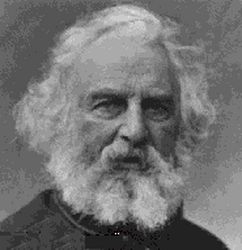
American poet ever filled out the part quite like Henry Wadsworth
Longfellow. One glance at the Moses-like profile on the
jacket of the
new Library of America edition of his selected poems and prose
confirms
as much, a silver-hued photograph taken late in his life that
makes it
appear as if the domed brow and furling beard were already
sculpted in
marble. The stately cadence of his name alone reverberates
with
gravitas: trochee, trochee, dactyl, a name that all but demands to
be
chiseled on the base of a bust or high on the portico of a
classical-revival library. And so it has been, time and
again, even as
his once-monumental repute has gradually eroded since his death in
1882.
Was he a great poet? He was certainly a grand poet, and in
the public
mind the grandest of his day and age. No American poet of
any era, it's
safe to say, has been both as awesomely prolific and prodigiously
popular. If Walt Whitman, his younger contemporary by a
dozen years, is enshrined as the founding father of modern
American poetry, Longfellow deserves no less than to be remembered
as the native bard who gave mythic dimension to the country's
historical imagination, a national poet of epic sweep and solemn
feeling who came along right at the moment when the emerging
nation had the most need for one. The forest primeval, the
village smithy under the spreading chestnut tree, the midnight
ride of Paul Revere, the Indian princeling Hiawatha in his birch
canoe -- such were the iconic images Longfellow forged out of the
American collective consciousness in volume after lionized
volume. The enduring artistry of his ceremonious and at
times overly starchy verse can be debated, but not the potency of
its ennobling sentiments or the
resounding strains it struck from what Lincoln famously invoked as
"the
mystic chords of memory."
Longfellow was born in Portland, Maine, in 1807, and educated at
Bowdoin College, where one of his classmates was Nathaniel
Hawthorne. A gifted linguist, he was appointed to a chair at
Harvard as a professor
of modern languages before he was thirty. By 1857, when The
Atlantic
Monthly was founded under the editorship of James Russell
Lowell,
Longfellow was in the prime of his writing life and incontestably
the
most celebrated poet in the land. His verse narrative
"The Song of
Hiawatha" (1855) had sold 50,000 copies; its successor,
"The Courtship of Miles Standish," racked up 10,000
purchases on its first day in London
when it appeared in 1858. This popular success, combined
with a nearly
unstinting critical acclaim (one notable dissenting voice belonged
to
Edgar Allan Poe, who years earlier had savaged Longfellow's Ballads
and
Other Poems in a review, fuming that its author's
"conception of the aim
of poetry is all wrong") won for Longfellow an audience and
eminence in
the nineteenth century that even such beloved American poets as
Frost
and Sandburg were not to rival in later generations.
|
| |
|
|
| |
|

|
We
have some
inspiring and motivational books that may interest you. Our main way of supporting this site is
through the sale of books, either physical copies
or digital copies for your Amazon Kindle (including the
online reader). All of the money that we earn
through them comes back to the site
in one way or another. Just click on the picture
to the left to visit our page of books, both fiction and
non-fiction! |
|
| |
|

|
|