|
More
from and about
M. Scott Peck
(biographical info at bottom of page) |
|
|
| |
|
The
difficulty we have in accepting responsibility for our behavior
lies in the desire to avoid the pain of the consequences of that
behavior. |
| |
|
Life is difficult. This is a great
truth, one of the greatest truths. It is a
great truth
because once we truly see this truth, we transcend it. Once
we truly know that life is difficult--once
we truly
understand and accept
it-- then life is no longer
difficult. Because once it is accepted, the fact
that
life is
difficult no longer matters.
Whenever we seek to avoid the responsibility for our own behavior,
we do so by attempting to give that responsibility to some other
individual or organization or entity. But this means we then give
away our power to that entity.
|
|
| |
Love is the will to extend
one's self for the purpose
of nurturing one's own or another's spiritual growth...
Love is as love does. Love is an act of will -- namely,
both an intention and an action. Will also implies
choice. We do not have to love. We choose to love.
It is in the whole process of
meeting and solving problems that life has meaning. Problems are the cutting
edge that distinguishes between success and failure. Problems call forth our
courage and our wisdom; indeed, they create our courage and our wisdom. It is
only because of problems that we grow mentally and spiritually. It is through
the pain of confronting and resolving problems that we learn.
|
| |
|
The truth is
that our finest moments are most likely to occur when
we are feeling deeply uncomfortable, unhappy, or
unfulfilled. For it
is only in such moments, propelled by our discomfort, that
we are
likely to step out of our ruts and start searching for
different ways
or truer answers.
|
| |
|
Life
is complex. Each one of us must make his own path through
life. There
are no self-help manuals, no formulas, no easy answers. The
right road for
one is the wrong road for another. . . The journey of life is not
paved in
blacktop; it is not brightly lit, and it has no road signs.
It is a rocky path
through the wilderness.
|
|
| |
|
If we know exactly where we're going, exactly
how to get there,
and exactly what we'll see along the way, we won't learn anything. |
| |
|
|
|
welcome
page
- contents
-
gallery
-
obstacles
-
quotations
- the
people behind the words
our
current e-zine
-
articles
and excerpts
- Daily
Meditations, Year
Two - Year Three
Sign up
for your free daily spiritual or general quotation ~ ~ Sign
up for your free daily meditation |
| |
|

|
| |
|
Love
is the free exercise of choice. Two people love each other only
when they
are quite capable of living without each other but choose to live
with each other. |
| |
|
How
strange that we should ordinarily feel compelled to hide our
wounds when we are all wounded! Community requires the ability
to expose our wounds and weaknesses to our fellow creatures.
It also requires the ability to be affected by the wounds of
others. . . But even more important is the love that arises among
us when we share, both ways, our woundedness. |
| |
|
All
my life I used to wonder what I would become when I grew up.
Then, about seven years ago, I realized that I was never going to
grow up--that growing is an ever ongoing process. |
| |
|

|
| |
|
I am
dubious as to how far we can move toward global community--which
is the only way to achieve international peace--until we learn the
basic
principles of community in our own individual lives and personal
spheres of influence.
The
Different Drum |
| |
If
you are determined not to risk pain, then you must do without many
things: having children, getting married, the ecstasy of
sex, the hope of
ambition, friendship--all that makes life alive, meaningful and
significant.
The
Road Less Traveled |
| |
|
The time and
the quality of the time that their parents devote to them
indicate to children the degree to which they are valued by their
parents. . . . When children know that they are valued, when they
truly feel valued in the deepest parts of themselves, then they
feel valuable. This knowledge is worth more than any gold.
The Road Less Traveled |
| |
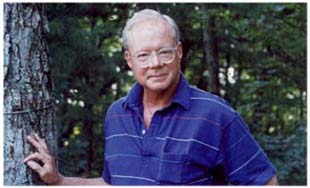
M.
Scott Peck was born on May 22, 1936 in New York City, the younger
of two sons to David Warner Peck, a prominent lawyer and jurist,
and his wife Elizabeth Saville. He married Lily Ho in 1959,
and they have three grown children.
Peck received his B.A. degree magna cum laude from Harvard College
in 1958, and his M.D. degree from the Case Western Reserve
University School of Medicine in 1963. From 1963 until 1972,
he served in the United States Army, resigning from the position
of Assistant Chief Psychiatry and Neurology Consultant to the
Surgeon General of the Army with the rank of Lieutenant Colonel
and the Meritorious Service Medal with oak leaf cluster.
From 1972 to 1983, Peck was engaged in the private practice of
psychiatry in Litchfield County, Connecticut.
On March 9, 1980 at the age of 43, Peck was nondenominationally
baptized by a Methodist minister in an Episcopalian convent (where
he has frequently gone on retreat).
Peck's first book, The Road Less Traveled, was published by
Simon & Schuster in 1978. The book has sold over six million
copies to date in North America alone, and has been translated
into over 20 languages.
Peck is a
nationally recognized authority on the relationship between
religion and science, and the science of psychology in particular.
In 1992 Dr. Peck was selected by the American Psychiatric
Association as a distinguished psychiatrist lecturer "for his
outstanding achievement in the field of psychiatry as an educator,
researcher and clinician."
Peck, although now "semi-retired," still does some
management consulting to top management of organizations in the
public, private, and non profit sectors, as well as occasional
writing and editing.
In 1984, Peck and his wife met with nine others to establish The
Foundation for Community Encouragement, a tax-exempt, nonprofit,
public educational foundation, whose mission is to promote and
teach the principles of Community. The Foundation (FCE) has
seventy selected and trained leaders who conduct workshops for the
general public and for organizations as diverse as churches,
schools, government agencies, prisons, universities and businesses
- throughout the world. Although now both retired from FCE's Board
of Directors, the Pecks continue to serve FCE in an
"elder" status which represents the rare privilege of
being able to give advice without having any responsibility.
As a result of his pioneering community building work, Dr. Peck is
the recipient of the 1984 Kaleidoscope Award for Peacemaking and
the 1994 Temple International Peace Prize. In 1996 he was also
recipient of The Learning, Faith and Freedom Medal from Georgetown
University.
|
| |
|
|
| |
|
|
We
have some
inspiring and motivational books that may interest you. Our main way of supporting this site is
through the sale of books, either physical copies
or digital copies for your Amazon Kindle (including the
online reader). All of the money that we earn
through them comes back to the site
in one way or another. Just click on the picture
to the left to visit our page of books, both fiction and
non-fiction! |
|
| |
|

|
|