|
More
from and about
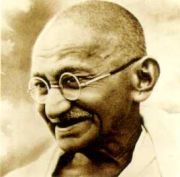
Mohandas Gandhi
(biographical info at bottom of page) |
|
|
| |
|
Live as if
you were to die tomorrow. Learn as if you were to live
forever. |
| |
|
God is the hardest
taskmaster I have known on this earth, and he tries
you through and through.
And when you find that your faith is failing or
your body is failing you, and
you are sinking, he comes to your assistance
somehow or other and proves to you
that you must not lose your faith
and that he is always at your beck and call,
but on his terms, not on your
terms. So I have found. I cannot really recall a
single instance when, at
the eleventh hour, he has forsaken me.
|

|
| |
|
People often become what they
believe themselves to be. If I keep on saying to myself that I cannot do a certain
thing, it is possible that I may end by really becoming
incapable of doing it. On the contrary, if I have the
belief that I can do it, I shall surely acquire the
capacity to do it even if I may not have it at the beginning.
|
| |
It is easy
enough to be friendly to one's friends. But to befriend the
one who regards him- or herself as your enemy is the
quintessence
of true religion. The other is mere business.
It's the
action, not the fruit of the action, that's important.
You have to do the right thing. It may not be in your
power, may not be in your time, that there'll be any
fruit. But that doesn't mean you stop doing the right
thing. You may never know what results come from your
action. But if you do nothing, there will be no result.
|
| |
|
Keep
your thoughts positive because your thoughts become your words.
Keep your words positive because your words become your behavior.
Keep your behavior positive because your behavior becomes your
habits. Keep your habits positive because your habits become your values.
Keep
your values positive because your values become your destiny.
I offer you peace. I
offer you love. I offer you friendship. I see your beauty. I hear
your need. I feel your feelings.
|
|
| |
|
They
cannot take away our self respect if we do not give it to them. |
| |
|

|
|
welcome
page
- contents
-
gallery
-
obstacles
-
quotations
- the
people behind the words
our
current e-zine
-
articles
and excerpts
- Daily
Meditations, Year
Two - Year Three
Sign up
for your free daily spiritual or general quotation ~ ~ Sign
up for your free daily meditation |
| |
|
There
is nothing that wastes the body like worry, and one who has
any faith in God should be ashamed to worry about anything
whatsoever. |
| |
|
You
must not lose faith in humanity. Humanity is like an ocean;
if a few drops of the ocean are dirty, the ocean does not become
dirty. |
| |
|
Prayer
is not asking. It is a longing of the soul. It is daily
admission of one's weakness. It is better in prayer to have
a heart without words than words without a heart. |
| |
|

|
| |
|
Mohandas
K. Gandhi was born in 1869 to Hindu parents in the state of
Gujarat in Western India. He entered an arranged marriage
with Kasturbai Makanji when both were 13 years old. His
family later sent him to London to study law, and in 1891 he was
admitted to the Inner Temple, and called to the bar. In
Southern Africa he worked ceaselessly to improve the rights of the
immigrant Indians. It was there that he developed his creed
of passive resistance against injustice, satyagraha, meaning truth
force, and was frequently jailed as a result of the protests that
he led.
Before he
returned to India with his wife and children in 1915, he had
radically changed the lives of Indians living in Southern
Africa. Back in India, it was not long before he was taking
the lead in the long struggle for independence from Britain.
He never wavered in his
unshakable belief in nonviolent protest and religious
tolerance. When
Muslim and Hindu compatriots committed acts of violence, whether
against the British who ruled India, or against each other, he
fasted until the fighting ceased.
Independence,
when it came in 1947, was not a military victory, but a triumph of
human will. To Gandhi's despair, however, the country was
partitioned into Hindu India and Muslim Pakistan. The last
two months of his life were spent trying to end the appalling
violence which ensued, leading him to fast to the brink of death,
an act which finally quelled the riots. In January 1948, at
the age of 79, he was killed by an assassin as he walked through a
crowed garden in New Delhi to take evening prayers.
|
| |
|
|
| |
|

|
We
have some
inspiring and motivational books that may interest you. Our main way of supporting this site is
through the sale of books, either physical copies
or digital copies for your Amazon Kindle (including the
online reader). All of the money that we earn
through them comes back to the site
in one way or another. Just click on the picture
to the left to visit our page of books, both fiction and
non-fiction! |
|
| |
|

|
|