|
loneliness |
|
home - obstacles
home - contents - solitude |
I
consider myself an expert on loneliness, though I
don't say that with pride or satisfaction.
That's just the way things have been for me. Our
family moved around constantly while I was young, so I
spent a lot of time by myself when I wished I was with
others. Both tendencies followed me into my
adult years-- moving a lot and spending a lot of time
alone-- so I've had plenty of time to feel loneliness,
ponder loneliness, and learn to dislike loneliness a
great deal.
I
don't regret those times at all. Through
loneliness I've learned the beauty and wealth and
necessity of solitude, and I've learned to be able to
do many things on my own that many people would love
to be able to do. I'm not bothered at all by
sitting alone at a table in a crowded restaurant, and
I'm not afraid to leave a negative situation just
because I might be alone. I never allowed myself
to be dragged into a negative relationship just
because I was afraid of being alone. I never
dread being alone, and I often look forward to it, for
I know just how healing it can be.
I
didn't marry until I was 38, either, so I had an awful
lot of time to learn about loneliness.
Here's
much of what I learned. I can't tell it all
because I'm not sure that I'm fully aware of all that
I've learned.
My
loneliness depends on my perspective. I can be
alone and be lonely, or I can be alone and enjoy the
quiet time and the chance I have to reflect, meditate,
be introspective.
|

|
|
When I'm with myself, I can
listen to whatever music I want, watch what I want on
TV (or turn it off when I want), and eat whatever I
feel like eating. There was a time when I would
have traded all of these freedoms for anything, but I
also finally reached a point before I met my wife at
which I appreciated these freedoms, and did my best to
take advantage of them. I can see being alone as
lonely, or I can see being alone as enjoying
solitude. It's up to me.
Loneliness
is very real. It's a very strong feeling that
can be very debilitating, and it's difficult to live
with. It affects a person to the depths of his
or her being, for in loneliness one sees oneself as
being rejected by other people who would rather be
with someone else--anyone else, we tell
ourselves. Somehow we're unacceptable,
undesirable, unlovable. We have plenty of time
to be alone to tell ourselves all these negative
things about ourselves.
And
how many people are afraid to leave destructive
relationships or marriages because they're afraid of
being alone?
In
hindsight, one of the most tragic things about my
loneliness was that much of it was caused by my fear
of rejection. I've learned when I was moving
away or when someone else was leaving that they really
wished they could have spent more time with me.
But I never picked up the phone to say "Hey,
let's get together" because I was afraid that
they would say no. My loneliness was bad, but it
was worse when I was spending time alone after being
rejected. But much of my loneliness, I now know,
could have been averted by a simple phone call now and
then. I could have gone hiking, could have gone
to movies, could have had more people over for dinner,
could have done a lot of things with lots of
people. Instead, I sat home alone.
And
by calling someone else, I might even have helped them
feel less lonely.
Jesus
went to the desert for forty days in order to be
alone. Most of our great spiritual leaders make
sure that they have plenty of time in their lives to
be alone. Our time alone is very important to
us--if we give it a chance and try to recognize the
lessons that it's trying to teach us. It's up to
us, though, to define that time--is it loneliness, or
is it solitude? How we see it, how we treat it,
and how we treat ourselves when we're with it make it
what it is.
Quotations
and passages on Solitude
|
|
| |
|
We
have all known the long loneliness and we have learned
that the only solution is love and that love comes with
community.
Dorothy
Day
|
| |
|

|
| |
Loneliness is the poverty of self;
solitude is the richness of self.
May Sarton |
| |
|
The
eternal quest of the individual human being
is to shatter his
or her loneliness.
Norman
Cousins |
| |
|
Our
loneliness is but our fear of life.
Eugene O'Neil |
| |
The
deepest need of the human being is to overcome our
separateness, to leave the prison of our loneliness.
Erich Fromm |
| |
|
Loneliness is black coffee and late-night
television;
solitude is herb tea and soft music.
Pearl Cleage
|
| |
|
People
who like themselves and realize that they are God's creation,
are never really lonely. It is only when we lose track
of our
own value, and our personal connection with the divine, that
we
are desperate for others to distract us from our loss.
Richard
Nelson
|
| |
The
secret to overcoming a feeling of loneliness is not going
outside
to meet people. That will only keep you from being
alone. The secret
is going inside yourself, to realize your true kinship with
God and
with all the human beings that he created.
Amy
Grant |
| |
|
What
should young people do with their lives today? Many
things,
obviously. But the most daring thing is to create stable
communities
in which the terrible disease of loneliness can be cured.
Kurt Vonnegut
Palm Sunday |
| |
|
My
life is spent in perpetual alternation between two rhythms,
the rhythm of attracting people for fear I may be lonely
and the rhythm of trying to get rid of them
because I know that I am bored.
C.E.M.
Joad
|
| |
|
|
|
quotations
- contents
-
welcome
page
-
obstacles
the
people behind the words
-
our
current e-zine
-
articles
and excerpts
Daily
Meditations, Year One - Year
Two - Year Three
- Year Four
Sign up
for your free daily spiritual or general quotation ~ ~ Sign
up for your free daily meditation
|
|
|
|
|
| |
Loneliness
is one of the most feared states in modern life. Perhaps
this fear has come about because so many of us have a vague
awareness
of a surging river of loneliness deep inside. Much of
our activity and
busyness is designed to keep that river within its banks.
Maybe loneliness has received a bad rap in
today's world. Maybe
loneliness is one of the ways our inner being communicates
with us,
letting us know that we need to take the time to get back in
touch with
ourselves. Could it be that the emptiness we feel in our
solar plexus
(and try so hard to avoid) is a friendly reminder that
something
(or someone!) has gone missing--we ourselves!
When we are lonely, it's usually a signal that we
need to spend
some time with ourselves. The next time you get this
signal,
try taking some time alone.
Anne
Wilson Schaef |
| |
|
Loneliness is like sitting in an
empty room and being aware of the space
around
you. It is a condition of separateness.
Solitude is becoming one
with the space around
you. It is a condition of union.
Loneliness
is small, solitude is large. Loneliness closes in
around you;
solitude expands towards the infinite.
Loneliness has its roots in words,
in an internal
conversation that nobody answers; solitude has its roots
in the great silence of eternity.
Most
people fear being alone because they understand only
loneliness.
Their understanding begins at the
self, and they are comfortable only
as long as they are
at the center of their understanding. Solitude is
about getting the "I" out of the center of our
thoughts so that other parts
of life can be experienced
in their fullness. It is about abandoning the
self
as the focus of understanding, and giving ourselves over
to
the great flowing fabric of the universe.
Kent Nerburn
Simple Truths |
| |
Never fear being alone, because you
never are.
Rod McKuen |
|
Loneliness can only truly be conquered
by those who appreciate solitude.
unattributed
|
|
There is no loneliness if one is
satisfied with oneself.
Hans-Ulrich Rieker
|
The worst loneliness is not to
be comfortable with yourself.
Mark Twain |
|
Being alone is a markedly different
experience than being lonely.
Clark E. Moustakas
|
|
|
|
|
Art thou
lonely, O my brother?
Share thy little with another!
Stretch a hand to one unfriended,
And thy loneliness is ended.
John
Oxenham
|
| |
|
|
| |
You
try being alone, without any forms of distraction, and
you will see how quickly you want to get away from
yourself and forget what you are. That is why
this enormous structure of professional amusement, of
automated distraction, is so prominent a part of what
we call civilization.
If you observe, you will see that people the world
over are becoming more and more distracted,
increasingly sophisticated and worldly. The
multiplication of pleasures, the innumerable books
that are being published, the newspaper pages filled
with sporting events--surely, all these indicate that
we constantly want to be amused. Because we are
inwardly empty, dull, mediocre, we use our
relationships and our social reforms as a means of
escaping from ourselves.
I wonder if you have noticed how lonely most people
are? And to escape from loneliness we run to
temples, churches, or mosques, we dress up and attend
social functions, we watch television, listen to the
radio, read, and so on. . . .
If you inquire a little into boredom you will find
that the cause of it is loneliness. It is in
order to escape from loneliness that we want to be
together, we want to be entertained, to have
distractions of every kind: gurus, religious
ceremonies, prayers, or the latest novel. Being
inwardly lonely we become mere spectators in life; and
we can be the players only when we understand
loneliness and go beyond it.
. . . because beyond it lies the real treasure.
J. Krishnamurti |
|
|
solitude
|
I remember my grandfather telling me how each
of us must live with a
full measure of loneliness that is inescapable, and we must
not destroy
ourselves with our passion to escape the aloneness.
Jim Harrison |
| |
|
At
the innermost core of all loneliness is a deep and
powerful
yearning for union with one's lost self.
Brendan Francis |
| |
|
I began to see that loneliness is neither good nor bad, but a point ofintense
and timeless awareness of the Self, a beginning which initiates
totally new
sensitivities and awarenesses, and which results in bringing a person deeply
in touch with his own existence and in touch with others in a fundamental
sense.
Clark E. Moustakas
Loneliness |
| |
|
|
| |
|
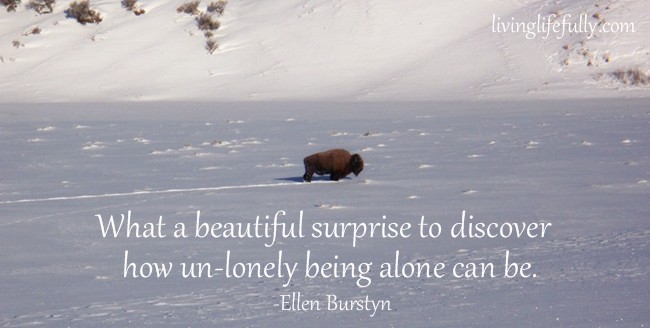
We
choose solitude. We think loneliness chooses us.
People fight loneliness because
they think it is a statement about their self-worth, instead
of a choice they have made.
You might be lonely because you've defined only a few
unavailable or select individuals
as worthy companions: your ex-lover or ex-spouse, your
adult children, someone who
is dead, or someone of your "class" and
accomplishments.
You are lonely because you are a discriminating person.
There are lots of people
available to be with if you are willing to seek them
out. Loneliness doesn't choose you,
you choose loneliness in preference to the alternatives.
There is nothing wrong with your
preference--just recognize it and adapt to the circumstances
that result. . . .
The difference between loneliness and solitude is your
perception of who you are
alone with and who made the choice.
Jennifer James |
| |
|
Lonely
people, in talking to each other can make each other lonelier.
Lillian
Hellman
|
| |
|
Any
decent society must generate a feeling of community.
Community offsets
loneliness. It gives people a vitally necessary sense of
belonging. Yet today
the institutions on which community depends are crumbling in
all the
techno-societies. The result is a spreading plague of
loneliness.
Alvin Toffler |
| |
|
|
We
have some
inspiring and motivational books that may interest you. Our main way of supporting this site is
through the sale of books, either physical copies
or digital copies for your Amazon Kindle (including the
online reader). All of the money that we earn
through them comes back to the site
in one way or another. Just click on the picture
to the left to visit our page of books, both fiction and
non-fiction! |
|
| |
|
If
someone listens or stretches out a hand or whispers a word of
encouragement or attempts to understand a lonely person,
extraordinary things begin to happen.
Loretta Firzaris |
|
|
|
Loneliness
does not come from having no people about one, but
from being unable to communicate the things that seem
important
to oneself, or from holding certain views which others find
inadmissible.
Carl Jung
|
| |
|
What we don't let out
traps us. We think, No one else feels this
way, I must be crazy. So we don't say anything. And we become
enveloped by a deep loneliness, not knowing where our feelings
come from or what to do with them. Why do I feel this way?
Sabrina Ward Harrison |
|
Quotations
and passages on Solitude
|
|
|
|
quotations
- contents
-
welcome
page
-
obstacles
the
people behind the words
-
our
current e-zine
-
articles
and excerpts
Daily
Meditations, Year One - Year
Two - Year Three
- Year Four
Sign up
for your free daily spiritual or general quotation ~ ~ Sign
up for your free daily meditation
|
| |
It is not
physical solitude that actually separates one from other
people,
not physical isolation, but spiritual isolation. It is
not the desert island
nor the stony wilderness that cuts you from the people you
love. It is
the wilderness in the mind, the desert wastes in the heart
through which
one wanders lost and a stranger. When one is a stranger
to oneself
then one is estranged from others, too. If one is out of
touch
with oneself, then one cannot touch others.
Anne
Morrow Lindbergh
Gift from the Sea |
| |
|
Loneliness,
far from revealing some defect, is proof that your innate
search for connection is intact. So instead of hiding
your loneliness,
bring it into the light. Honor it. Treat it.
Heal it.
You'll find that it returns the favor.
Martha Beck |
| |
|
It's important
to note that loneliness and being alone are very
different things. Being alone or inhabiting solitude can
be a powerful
and healing thing. As an introvert, I deeply value alone
time, and I
often feel the loneliest when I'm with other people. In
our house,
we call that sense of being disconnected "the lonely
feeling."
I can't tell you the number of times I've called Steve from
the road
and said, "I've got the lonely feeling." The
cure is normally a quick
chat with him and the kids. It seems counterintuitive,
but Steve
then usually advises, "You may need some time alone in
your hotel
room." To me it's a great cure. I don't think
there's anything
lonelier than being with people and feeling alone.
Brené Brown
Braving the Wilderness |
| |
|
Loneliness
is such an omnipotent and painful threat to many persons
that they have little conception of the positive values of
solitude, and
even at times are very frightened at the prospect of being
alone. Many
people suffer from “the fear of finding oneself alone,”
remarks André
Gide, “and so they don’t find themselves at all.”
Rollo May
Man's Search for Himself
|
| |
|

|
|
|