arrogance
|
|
home
- contents - obstacles
contents
|
| |
|
I
don't have nearly as much of a problem with arrogant
people now as I used to. I used to take their arrogance
personally, as if it meant something to me when an
arrogant person treated me as an inferior. Now, though, I
realize that arrogance is merely a mask for people who
feel even more inferior than I do. The only way they've
learned of compensating for their own insecurities is to
put others down, to try to make them feel like crap, so
that they can feel better themselves. Redfield touches on
this dynamic in The Celestine
Prophecy--by putting others down,
they're draining energy from them, and taking it for
themselves.
I don't give them the satisfaction any longer. An
arrogant person can't make me feel bad any more, because
it's so easy to see through them once you know that they're
faking it. They've put on this mask because they fear
that others will see through them, will understand that
no, they're not happy. I see arrogance as a sad state now,
a state in which people try to hide behind their money or
their breeding or their social standing or their
positions of "power," but a state in which they'll
never be able to let their true selves shine through.
The film
Regarding Henry
gives a glimpse of what could happen if one sort of
arrogance-- the power-based kind --were taken away, and a
man were to allow his own fundamental honesty shine
through. Of course we could enter into an hours-long
discourse about his diminished mental capabilities, but
we don't need to do so.
|

|
|
Fundamentally, Henry (Harrison
Ford) becomes a happier man because he no longer needs to
hide behind the power of his position in order to make
himself feel better.
It's interesting that Hollywood so often equates humility
with diminished mental powers. I read an interesting
column about the parallels between Regarding
Henry and Forrest
Gump, in which the author examined
the fact that two Hollywood heroes of the same year were
basically shown as not very intelligent, to be diplomatic. The beauty of these two films is in the lack of arrogance
of the characters, not in their mental abilities. Robin
Williams regularly makes films about nice men who are
doing their best to live life, without being arrogant. In
his films, the arrogant people are often shown as the
weak people they truly are. (The exception is Mrs. Doubtfire, in
which his character is so arrogant that he never sees the harm
he's caused his family, and even blames his current situation
on his wife, who stuck by him as long as she could through his
broken promises and lack of responsibility.)
In
the world of literature, possibly the most effective
arrogant character ever created is Ivan Ilych, in Tolstoy's
"The Death of Ivan Ilych." This is a man who
married because it was the right thing to do, who started
to stay out with his friends because his family started
annoying him, who loved the power of the bench (he was a
judge), but who comes to the end of his life and finally
admits to himself: It was all wrong. Everything he ever
did--his whole life--was wrong. His funeral, at which his
friends wonder who's going to get his job and his wife
complains that she won't be able to live on the pension
she'll receive, is incredibly painful. Ilych is very
similar to Dickens' Scrooge, but Scrooge gets a second
chance, an opportunity to change his ways. Ilych sees the light,
but only upon his death bed when it's too late to do anything
about it.
Be
arrogant if you wish. Look down on others and treat them
poorly, if you wish. But realize that if you do so, you're
only allowing your own inner weaknesses to shine through, and while some
people may be fooled and consider you simply arrogant, most
others will see that you're fooling yourself more than anyone
else, and that you're not nearly as "superior" as
you act and claim.
And for those who must deal with arrogance on a regular
basis, please keep in mind that arrogant people treat you
poorly only because they're needier than you, and they
haven't yet admitted to themselves that they are needy. They need and deserve your compassion, not your anger.
|
|
| |
|
Arrogance
diminishes wisdom.
Arabian proverb |
| |
|
|
|
quotations
- contents
-
welcome
page
-
obstacles
the
people behind the words
-
our
current e-zine
-
articles
and excerpts
Daily
Meditations, Year One - Year
Two - Year Three
- Year Four
Sign up
for your free daily spiritual or general quotation ~ ~ Sign
up for your free daily meditation
|
| |
|
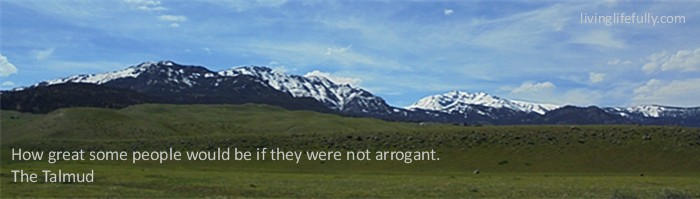
How great
some people would be if they were not arrogant.
The
Talmud
|
| |
|
Arrogance is the obstruction of wisdom.
Bion of Smyrna |
| |
|
When
people are most sure and arrogant, they are commonly
the most mistaken, and have then given views to passion,
without that proper deliberation and suspense which can
alone secure them from the grossest absurdities.
David
Hume
|
| |
|

|
| |
Anyone who does not exercise compassion is ignorant of the reality
that everyone needs it at some time in life; or we forget that someone
has blessed us with compassion at a time when we needed it. That
is
the smallness of arrogance. It is a disease of the soul.
It can be highly
contagious. Ignorance is its carrier. It ravages the souls
of those who
think there is no reality beyond themselves. Those who suffer
from the
smallness of arrogance think that ill fortune is the fault of those
who
suffer it; that good fortune is a privilege that belongs to
them. Whatever
path you take, Grandson, do not succumb to arrogance and endanger your
soul.
Joseph M. Marshall III |
| |
|
Arrogance means that one knows how to press forward but not
how to draw back, that one knows existence but not annihilation,
knows something about winning but nothing about losing.
I Ching |
| |
|
Arrogance is a mixture of impertinence, disobedience, indiscipline,
rudeness, harshness and a self-assertive nature.
Sivananda |
| |
|
Early in my
career, I had to choose between an honest arrogance
and a hypercritical humility. I deliberately choose an
honest arrogance, and I've never been sorry.
Frank Lloyd Wright |
| |
|
Arrogance is a
creature. It does not have senses.
It has only a sharp tongue and the pointing finger.
Toba Beta |
| |
|
Ignorance
is a horrible thing. But arrogance, the belief that knowing a
little more than the ignorant makes you wise, is more horrible still.
James Rozoff
|
| |
|
|
| |
|
There
is a wicked and pervading arrogance loose on the earth,
like a rabid beast, an overdog. Does it run, does it slouch,
does
its name have a number? The beast preaches contempt, for that's
what arrogance says: that nothing is real but itself, and the
bone
and blood of another's being are insubstantial as breath.
Kelly Cherry |
| |
|
We have come to
look at our planet as a resource for our species, which
is funny when you think that the planet has been around for about five
billion years, and Homo sapiens for perhaps one hundred thousand.
We
have acquired an arrogance about ourselves that I find
frightening. We have
come to feel that we are so far apart from the rest of nature
that we have but to command.
Marston Bates
|
| |
|
Nobody who is
somebody looks down on anybody.
Margaret Deland |
| |
|
The arrogance of age must submit to be taught by
youth.
Edmund Burke |
| |
|
Arrogance really comes
from insecurity, and in the end our feeling
that we are bigger than others is really the flip side
of our feeling that we are smaller than others.
Desmond Tutu
Believe
|
| |
|
Arrogance,
boastfulness, and the overestimation of our abilities
reflects underdeveloped self-esteem rather than, as some
people imagine, too much self-esteem.
Nathaniel
Branden
Self-Esteem Every Day |
| |
|

|
We
have some
inspiring and motivational books that may interest you. Our main way of supporting this site is
through the sale of books, either physical copies
or digital copies for your Amazon Kindle (including the
online reader). All of the money that we earn
through them comes back to the site
in one way or another. Just click on the picture
to the left to visit our page of books, both fiction and
non-fiction! |
|
| |
|
The
opposite of humility is arrogance--the belief that we are wiser
or better than others. Arrogance promotes separation
rather than
community. It looms like a brick wall between us
and those from whom we could learn.
John Marks
Templeton
Worldwide Laws of Life |
| |
|
I didn't know that there was a
thin line between ignorance and arrogance.
Faraaz Kazi
Truly, Madly, Deeply
|
| |
|
Arrogance
likes to appear humble in public.
Toba Beta
Master of Stupidity |
| |
|
|
| |
Arrogance makes you stronger from outside, but even weaker from
inside.
Ujas Soni |
| |
|
When you judge another’s religion then your
beliefs are finally judged,
humility sets in. At this point, God smiles because he finally
got you to
recognize arrogance. Blessed is the person that steps outside
their
beliefs for one day to absorb a different perspective on life.
From that
perspective you will not only learn about others but finally see your
true self.
Shannon L. Alder |
| |
|
When you think
yours is the only true path you forever chain yourself to
judging others and narrow the vision of God. The roads to
righteousness
and arrogance are parallel roads that can intersect each other several
times
throughout a person's life. It’s often hard to recognize one
road from
another. What makes them different is the road to righteousness
is paved
with the love of humanity. The road to arrogance is paved with
the love of self.
Shannon L. Alder |
| |
|
|
|
|