|
More
from and about
Robert Louis Stevenson
(biographical info at bottom of page) |
|
|
| |
|
To
become what we are capable of becoming is the only end in
life. |
| |
|
To
be wealthy, a rich nature is the first requisite and money but the second.
To be of a quick and healthy blood, to share in all honorable curiosities,
to be rich in admiration and free from envy, to rejoice greatly in the
good
of others, to love with such generosity of heart that your love is still
a dear possession in absence or unkindness—these are the gifts of
fortune
which money cannot buy, and without which money can buy nothing.
To know what you prefer
instead of humbly saying Amen to what the world tells you you ought to prefer,
is to have kept your soul alive.
|

|
| |
If
you teach people to keep their eyes upon what others think of them,
unthinkingly to lead the lives and hold the principles of the majority
of their contemporaries, you must discredit in their own eyes the
authoritative voices of their own souls. They may be docile
citizens;
they will never be men and women. It is ours, on the other hand,
to disregard this babble and chattering of other people better and
worse than we are, and to walk straight before us by what light we have.
They may be right; but so, before heaven, are we. They may know;
but we know also, and by that knowledge we must stand or fall. There is such a thing as loyalty to one's own better self; and from
those
who have not that, God help me, how am I to look for loyalty to others?
In each of us, two natures
are at war--the good and the evil. All our lives the fight goes on between
them, and one of them must conquer. But in our own hands lies the power to
choose--what we want most to be we are.
|
| |
|
Quiet
minds cannot be perplexed or frightened,
but go on in
fortune or misfortune at their own private pace,
like a
clock during a thunderstorm.
|
| |
|
The cruelest lies
are often told in silence. One may have
sat in a room for hours and not opened his mouth, and yet
come out of that room a disloyal friend or a vile calumniator.
|
|
| |
|
To be
wholly devoted to some intellectual exercise is to have succeeded in
life. |
| |
|

|
|
quotations
- contents
-
welcome
page
- obstacles
- weblog
the
people behind the words
- our
current e-zine
- articles
and excerpts
Daily
Meditations, Year One - Year
Two - Year Three - Year
Four
Simple
and Profound website
Sign up for your free email daily
spiritual or general quotation
Sign
up for your free email daily meditation |
| |
|
For
God's sake give me the young person who has
brains enough to make a fool of him or herself! |
| |
|
As
yesterday is history, and tomorrow may never come,
I have
resolved from this day on, I will do all the business
I can honestly,
have all the fun I can reasonably, do all
the good I can willingly,
and save my digestion
by thinking pleasantly.
|
| |
|
Do
not forget that even as "to work is to worship"
so to be cheery is to worship also, and to be happy
is
the first step to being pious.
|
| |
|

|
| |
|
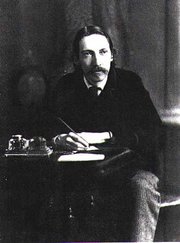
Stevenson
was born Robert Lewis Balfour Stevenson in Edinburgh,
Scotland, the son of Thomas Stevenson and grandson of Robert
Stevenson, both successful lighthouse engineers, and Margaret
Balfour. He studied at Edinburgh Academy in his youth. His
parents were both very religious. Robert gave up the
religion of his parents while studying at Edinburgh University,
but the teaching that he received as a child continued to
influence him.
Although ill with
tuberculosis from childhood, Stevenson had a full
life. He began his education as an engineer but, despite his
family
history, he showed little aptitude and soon switched to studying
law. At
the age of 18 he dropped the name Balfour and changed his middle
name
from Lewis to Louis (but retaining the original pronunciation);
from
this time on he began styling himself "RLS." He
turned to the law
because of poor health, but he never practiced. He ended his
life as a
tribal leader (called by his tribe Tusitala, meaning
"storyteller" in
Samoan) and plantation owner at his residence "Vailima"
in Samoa, all
this in addition to his literary career.
Stevenson's
novels of adventure, romance, and horror are of
considerable psychological depth and have continued in popularity
long
after his death, both as books and as films.
Stevenson's grave
on Mt Vaea, Samoa. His wife Fanny, whom he married in 1880,
was a great support in his adventurous and arduous life.
Stevenson made
several trips to the Kingdom of Hawaii and became a good friend of
King David Kalakaua with whom Stevenson spent much time.
Stevenson also became best friends with the king's niece Princess
Victoria Kaiulani, also of Scottish heritage. Since the
tragic deaths of
both Stevenson and Kaiulani, historians have debated the true
nature of
their relationship as to whether or not they had romantic feelings
for
each other. Because of the age difference, such stories have
often been discredited. In 1888, Stevenson traveled to the
island of Molokai just weeks after the death of Father
Damien. He spent twelve days at the missionary priest's
residence, Bishop Home at Kalawao. Stevenson taught the
local girls to play croquet. When Congregationalist and
Presbyterian ministers began to incite slander against Father
Damien out of spite for his Catholicism, Stevenson wrote one of
his most famous essays in defense of the life and work of the
missionary priest.
Stevenson died of
a brain (cerebral) hemorrhage in Vailima in Samoa,
aged 44. In his will, he bequeathed his birthday to a little
girl who
had been born on Christmas Day.
|
| |
|
|
| |
|

|
We
have some
inspiring and motivational books that may interest you. Our main way of supporting this site is
through the sale of books, either physical copies
or digital copies for your Amazon Kindle (including the
online reader). All of the money that we earn
through them comes back to the site
in one way or another. Just click on the picture
to the left to visit our page of books, both fiction and
non-fiction! |
|
| |
|

|
|