|
hurry |
|
home
- contents - obstacles
contents
|
|
slowing down
- impatience
|
|
I hurried to work the other day, for I was running late.
It doesn't happen to me often, for I usually try to get places
early (though I don't often succeed--usually I get there right
around the time I'm supposed to be there). But even if I'm
late, I usually don't hurry--too many bad things can happen when
I'm in a hurry, and I can make mistakes that I normally wouldn't
make. When I'm driving in my car, I don't want to make
mistakes.
Since it was just a one-time thing, it didn't bother me too
much to be in a hurry. And even though I was hurrying, I
didn't hurry that much--I still stopped to get a snack that I knew
I'd need, I didn't speed or drive recklessly, and I didn't
disregard others simply because I was rushing. But the
experience did make me think quite a bit about just how much our
culture values the concept of hurrying things and people.
As the world grows smaller with technological and
transportation advances, we see more and more a tendency to want
to have everything done yesterday. Most of us like most of
the ramifications of this tendency--we can order a book online and
it can be at our home in two days in many cases. We can get
our photos back in an hour, and we can have our oil changed and
our car lubed in just twenty minutes.
But the benefits do have their price. Much of that price
is in the way that people feel more pressure to perform quickly,
often at the expense of quality. Many people aren't wired
for that kind of work--they're much more suited for jobs that
allow them to focus on details, to take their time and do their
jobs right.
|

|
|
I also can't help but think that some of the
computer problems I've run into in the last few weeks result from
the manufacturer having strict quotas, needing to crank out a
certain number of units per day.
Hurrying in the workplace can lead to drastic effects on
people, especially forced hurrying. Stress levels climb when quotas are in place, and it
becomes very easy to dread our jobs, knowing before we go in each
day that we're going to be judged on our performance based on the
number of products we produce. And in our hurry to reach the
quotas, we may let something go by that we otherwise wouldn't
have, and our personal satisfaction in the job we're doing
suffers. Once the inferior product reaches the consumer,
there's another round of dissatisfaction that someone else has to
deal with. All because we as a society value speed almost
above all else--but can we have our speed and our satisfaction,
too?
But
that's hurry on the job--what about in our personal lives?
Why do so many people feel that so many things have to be done
right this moment? Why do so many people feel they need to
be everywhere two minutes ago?
One of
the reasons I try to get to work early is that I like to enjoy the
trip to work. If I'm driving or walking, it doesn't
matter--I want to enjoy getting there. I want to experience
my surroundings -- the air, the trees, the people, just the fact of
being alive. When I take my time I get there much more
relaxed, too--much more ready to start my day in a positive
way. When I hurry, I'm not relaxed at all -- I get to work
feeling all the residual stress that hurrying causes, and it takes
me a while before that stress leaves and allows me to do my work
effectively. When
I hurry I also don't get to know a lot about people with whom I
share this planet. I don't have time for a casual chat, to
take a few minutes to listen to someone's experience from
yesterday (and maybe even learn something from it!), or to give
someone a small piece of advice. I have to tell everyone
"Sorry--I'm in a hurry!" and take off, and I get nothing
from those people, and they get nothing from me. When
I'm hurrying, my focus also shifts to time, and how much of it is
going by how quickly. I don't focus on doing the best job I
can or making sure that everything's done correctly--I just focus
on the process of trying to hurry things up. We all see it
and hear it time and again--when you hurry, you make mistakes, and
those mistakes probably would have been avoided if you had taken
your time to do the job right. One
of the most tragic results of hurrying happened in our town last
year when a mother was taking her two kids to a Little League
game. She was late and in a hurry, and when she passed a car
on a double yellow she hit another car head-on. Her two
children died--all because she was in a hurry and she was
focusing on hurrying rather than getting somewhere safely.
It was a completely needless tragedy that happened because she
thought she could arrive ten minutes late instead of twelve or
thirteen minutes late. Most
of our mistakes when we hurry aren't that drastic, of course, but
we can never know the far-reaching implications of things that we
do poorly because we don't give them the time and attention they
deserve. It's in our control, though--we can choose not to
hurry, and though we may be a bit late or later with the finished
product or to get to our next destination, remember that life was
meant for living, not hurrying. Get the most out of where
you are--right here, right now--and try to plan your day and
activities with enough time to get done the things that need to be
done. Get there thirteen minutes late if you need to, rather
than hurrying so that you can arrive ten minutes late.
|
|
| |
|
Perhaps
it would be a good idea, fantastic as it sounds, to muffle every
telephone, stop every motor and halt all activity for an hour some day
to
give people a chance to ponder for a few minutes on what it is all
about,
why they are living, and what they really want.
James Truslow Adams
|
| |
|

|
|
quotations
- contents
-
welcome
page
-
obstacles
the
people behind the words
-
our
current e-zine
-
articles
and excerpts
Daily
Meditations, Year One - Year
Two - Year Three
- Year Four
Sign up
for your free daily spiritual or general quotation ~ ~ Sign
up for your free daily meditation
|
|
|
|

|
| |
We
are in such haste to be doing, to be writing, to be gathering gear,
to make our voice audible a moment in the derisive silence of eternity,
that we forget one thing, of which these are but the parts—namely,
to
live. We fall in love, we drink hard, we run to and fro upon the earth
like frightened sheep.
And now you are to ask yourself if, when all is done,
you would not have been better to sit by the fire at home, and be
happy
thinking. To sit still and contemplate . . . is this not to know
both wisdom and
virtue,
and to dwell with happiness?
Robert Louis Stevenson |
| |
|
The
West has made people too time-conscious, not knowing where they
are going but speeding to get there because time is short.
Bhagwan Shree Rajneesh |
| |
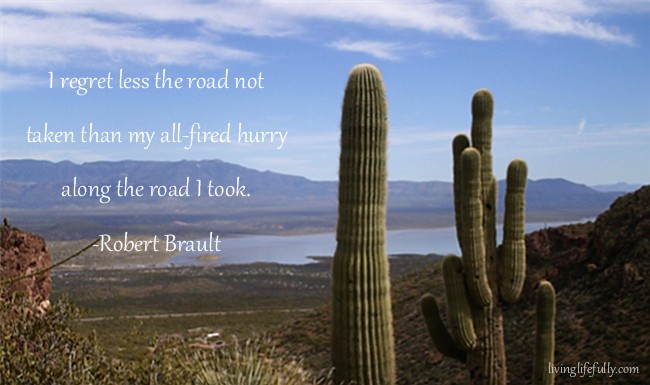
I
regret less the road not taken than my all-fired hurry along the
road I took.
Robert Brault |
|
Remember
the great adversity of art or anything else is a hurried life.
Robert James Waller |
|
If you are in a hurry you will never get there.
Chinese Proverb |
|
| |
|

|
We
have some
inspiring and motivational books that may interest you. Our main way of supporting this site is
through the sale of books, either physical copies
or digital copies for your Amazon Kindle (including the
online reader). All of the money that we earn
through them comes back to the site
in one way or another. Just click on the picture
to the left to visit our page of books, both fiction and
non-fiction! |
|
| |
|
Half
our life is spent trying to find something to do with
the time we
have rushed through life trying to save.
Will Rogers
(This is a quotation that could
be modified easily:
Half our life is spent trying to
find the time
we have rushed through life trying to save.) |
|
| |
Slow
down and take the time to really see. Take a moment
to see
what is going on around you right now, right where
you are.
You may be missing something wonderful.
J.
Michael Thomas
|
| |
|
If you could once make
up your mind never to
undertake more work
than you can carry on calmly, quietly, without
hurry or flurry. . . . and
if the instant you feel yourself growing
nervous and out of breath, you
would
stop and take breath, you would
find
this simple common-sense
rule doing for you what
no prayers or
tears could ever accomplish.
Elizabeth Prentiss |
| |
|
The
feeling of being hurried is not usually the result of living a full life
and
having no time. It is, rather, born of a vague fear that we are
wasting our life.
Eric Hoffer |
| |
|
|
| |
|
We
are naturally reverent beings, but much of our natural reverence
has been torn away from us because we have been born into a world
that hurries.
There is no time to be reverent with the earth or with each
other.
We are all hurrying into progress.
And for all our hurrying
we lose sight of our true nature a little more each day.
Macrina Wiederkehr |
| |
|
The
Rabbi of Berdichev saw a man
running down the street.
He asked the man, "Why are
you hurrying so?"
"I'm rushing to find my
livelihood," the man
answered.
"And how do you know," the
rabbi asked, "that
your livelihood
is running ahead of you?
Maybe it's behind you, and
all you need
to do is stop running
and it will catch up to you."
traditional Chassidic
Jewish story
|

|
|
| |
|
In
the deep jungles of Africa, a traveler was making a long trek.
Natives had been
engaged from a tribe to carry the loads. The first day they marched
rapidly
and went far. The traveler had high hopes of a speedy journey.
But the second morning these jungle tribesmen refused to move.
For some strange reason they just sat and rested. On inquiry as to
the reason for this strange behavior, the traveler was informed that they
had gone too fast the first day, and that they were now waiting
for their souls to catch up with their bodies.
This whirling rushing life which so many of us live does for us
what that first march did for those jungle tribesmen. The
difference: they
knew
what they needed to restore life's balance; too often we do not.
Lettie
Cowman
|
| |
|
Recently I've begun to slow down and do things one at a
time. I'm
inspired--and simultaneously exasperated--by my son who, like
most six-year-olds, likes to take his time to get to where he wants to be.
It's as if he truly savors the path more than the destination. As I
prod him
to "hurry up," he slows down to relish his journey even more.
Leslie Levine |
| |
|
|
| |
I remembered one morning when I
discovered a cocoon in the bark
of a
tree, just as the
butterfly was making a hole in its case
and preparing to
come out. I waited a while, but it was too long appearing
and I was
impatient. I bent over it and breathed on it to
warm it. I warmed it
as quickly as I could and the
miracle began to happen before my eyes,
faster than life. The case opened, the butterfly started slowly crawling
out
and I shall never forget my horror when I saw how its
wings
were
folded back and crumpled; the wretched
butterfly tried
with its whole
trembling body to unfold
them. Bending over it,
I tried
to help it with my
breath. In vain. It needed to be hatched out patiently
and the
unfolding
of the wings should be a gradual process in the
sun. Now it was too late.
My breath had forced the
butterfly to appear,
all crumpled, before its
time. It
struggled desperately and,
a few seconds later,
died in
the palm of my hand.
That little body is, I do believe, the greatest weight
I
have
on my
conscience. For I realize today that it is a
mortal sin
to violate the
great laws of nature. We should
not hurry,
we should not be
impatient, but we should
confidently
obey the eternal rhythm.
Nikos Kazantzakis
from Zorba the Greek |
|
|
|
And to this
day I wish I had lingered a week or so. . . . But we stupid
mortals, or most of us, are always in haste to reach somewhere else,
forgetting that the zest is in the journey and not in the destination.
Ralph D. Paine
Roads of Adventure
|
|
|
|
slowing down
- impatience
|
|
|
|
quotations
- contents
-
welcome
page
-
obstacles
the
people behind the words
-
our
current e-zine
-
articles
and excerpts
Daily
Meditations, Year One - Year
Two - Year Three
- Year Four
Sign up
for your free daily spiritual or general quotation ~ ~ Sign
up for your free daily meditation
|
| |
There's
an old Italian proverb: Qui va piano, va sano, va lentano.
That means: "The person who goes quietly, goes with health
and
goes far." Hurrying up and using a lot of shortcuts
doesn't get us very far at all.
Fred Rogers
The
World According to Mr. Rogers |
| |
|
Rivers know this: there is no hurry. We shall
get there some day.
A.A. Milne |
| |
The average American sees just about as much of real life, of the things worth while, as
we see of the beautiful scenery through which we pass, driving
our cars at high speeds. Of course now and then we
divert our eyes long enough to get a hasty glimpse of a mountain peak or a beautiful valley or a gorgeous sunset, but the beautiful scenery, the details of the glorious flowers, are all lost upon
us.
All the wonderful details of little experiences, the fine courtesies, the exquisite things of life, the things that are worth while, are lost to us because we live at such a terrific pace.
We cannot take time to see things, to appreciate them, to enjoy them.
We do not take time to enjoy our friends. Our whole mind is anxiously focused upon the machine and the road in front of us.
We are like the men who carried the mails on the pony express.
We are borne along at a terrific speed, and we only dismount to mount again.
And so we go tearing through life forever changing from a tired to a fresh pony.
Bent forms, premature gray hair, heavy steps, and feverish haste are indicative of American life. Restlessness and discontent have become chronic, and are characteristic of our age and nation.
This straining, struggling, and striving is not life; it is a fever, a disease, well named
Americanitis. It bears no relation to happiness.
Orison
Swett Marden
The Joys of Living (1913)
|
|
| |
|
|
|