|
More
from and about
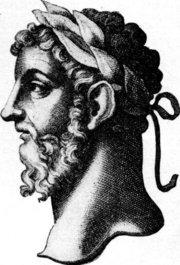
Marcus Aurelius
(biographical info at bottom of page) |
|
|
| |
|
It
is not death that we should fear, but we
should fear never beginning to live. |
| |
|
Why
should anyone be afraid of change? What can take place without it?
What can be more pleasing or more suitable to universal Nature?
Can you take your bath without the firewood undergoing a change?
Can you eat, without the food undergoing a change? And can
anything
useful be done without change? Don't you see that for you to
change
is just the same, and is equally necessary for universal Nature?
|

|
| |
Do
not fear death, but welcome it, since it too comes from nature.
For just as
we are young and grow old, and flourish and reach maturity, have teeth
and
a beard and grey hairs, conceive, become pregnant, and bring forth new
life,
and all the other natural processes that follow the seasons of our
existence,
so also do we have death.
A thoughtful person will never take death lightly,
impatiently, or scornfully,
but will wait for it as one of life's natural processes.
|
| |
Why
should anyone be afraid of change? What can
take place without it? What can be more pleasing
or more suitable to universal nature?
Can you take your bath without the firewood undergoing
a change? Can you
eat without the food undergoing a change? And can anything useful be done
without change?
Don't you see that for you to change is just the same,
and is equally necessary
for universal nature?
|
| |
|
All things are linked with one another, and this
oneness is sacred; there is
nothing that is not interconnected with everything else. For
things are
interdependent, and they combine to form this universal order.
There is
only one universe made up of all things, and one creator who pervades
them; there is one substance and one law, namely, common reason in all
thinking creatures, and all truth is one--if, as we believe, there is
only
one path of perfection for all beings who share the same mind.
|
|
| |
|
"Sweep
me up and send me where you please." For there I will
retain my spirit, tranquil and content, as long as it can feel and
act
in harmony with its own nature. Is a change of place enough
reason
for my soul to become unhappy and worn, for me to become
depressed, humbled, cowering, and afraid? Can you discover
any reasons for this?
|
| |
|

|
|
quotations
- contents
-
welcome
page
- obstacles
- weblog
the
people behind the words
- our
current e-zine
- articles
and excerpts
Daily
Meditations, Year One - Year
Two - Year Three - Year
Four
Simple
and Profound website
Sign up for your free email daily
spiritual or general quotation
Sign
up for your free email daily meditation |
| |
|
Always
follow these two rules:
first, act only on what your reasoning mind proposes
for the good of humanity, and second, change your opinion if someone
shows
you it’s wrong.
This change of mind must proceed only from the conviction that
it’s
both correct and for the common good, but not because it will give you
pleasure and make you popular. |
| |
|
Think of the whole being, of which you have a pittance;
and the totality of time, of which a small measure has been set for you;
and of everything that is arranged by destiny, and how tiny your role in
it. |
| |
|
Anyone who
has seen the present day has seen it all, both everything
that has taken place since time began and everything that will be
for all eternity; for all things are of one kind and one form. |
| |
|

|
| |
Imperator
Caesar Marcus Aurelius Antoninus Augustus (April 26, 121 –
March 17, 180) was Roman Emperor from 161 to his death in
180. He was born Marcus Annius Catilius Severus, and at
marriage took the name
Marcus Annius Verus. When he was named Emperor, he was given
the name Marcus Aurelius Antoninus. He was the last of the
Five Good Emperors.
While on campaign between 170 and 180, Aurelius wrote his Meditationsas a source for his own guidance and self-improvement. He
had been a
priest at the sacrificial altars of Roman service and was an eager
patriot. He had a logical mind though his notes were
representative of
Stoic philosophy and spirituality. Meditations is
still revered as a
literary monument to a government of service and duty. It
has been
praised for its "exquisite accent and it's infinite
tenderness" and
"saintliness" being called the "gospel of his
life." They have been
compared by J. S. Mill in his Utility of Religion to the Sermon on
the
Mount. Like many of the emperors of Rome he was loved by the
people. Yet, with all his benevolence, administered justice and reforms he
often
mistrusted the Christians whom he subjected to systematic
persecution.
Marcus Aurelius died on March 17, 180 during the expedition
against the
Marcomanni in the city of Vindobona (modern Vienna). His
ashes were
returned to Rome and rest in Hadrian's mausoleum (modern Castel
Sant'Angelo). He was able to secure the succession for his
son Commodus, whom he made co-emperor in his own lifetime (in
177), though the choice may have been unfortunate. Commodus
was a political and military outsider, as well as an extreme
egotist. Many historians believe that the decline of Rome
began under Commodus. For this reason, Aurelius' death is
often held to have been the end of the Pax Romana.
|
| |
|
|
| |
|

|
We
have some
inspiring and motivational books that may interest you. Our main way of supporting this site is
through the sale of books, either physical copies
or digital copies for your Amazon Kindle (including the
online reader). All of the money that we earn
through them comes back to the site
in one way or another. Just click on the picture
to the left to visit our page of books, both fiction and
non-fiction! |
|
| |
|

|
|