|
More
from and about
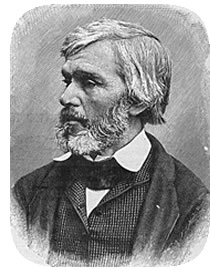
Thomas Carlyle
(biographical info at bottom of page) |
|
|
| |
|
The
person who cannot wonder is but a pair
of spectacles behind which there is no eye. |
| |
|
If
Jesus Christ were to come today, people would not even
crucify him. They would ask him to dinner, and hear what he
had to say, and make fun of it.
|

|
| |
|
Wondrous is the strength of
cheerfulness, and its
power of endurance - the cheerful man will do more
in the same time, will do it better, will preserve
it longer, than the sad or sullen.
|
| |
|
War is a
quarrel between two thieves too cowardly to fight
their own battle; therefore they take boys from one village
and another village, stick them into uniforms, equip them
with
guns, and let them loose like wild beasts against one other.
|
| |
|
Silence
is the element in which great things fashion themselves together;
that at length they may emerge, full-formed and majestic, into the
daylight of Life, which they are thenceforth to rule. Not William
the Silent only, but all the considerable men I have known, and
the most undiplomatic and unstrategic of these, forbore to babble
of what they were creating and projecting. Nay, in thy own mean
perplexities, do thou thyself but hold thy tongue for one day: on
the morrow, how much clearer are thy purposes and duties; what
wreck and rubbish have those mute workmen within thee swept away,
when intrusive noises were shut out! Speech is too often not, as
the Frenchman defined it, the art of concealing Thought; but of
quite stifling and suspending Thought, so that there is none to
conceal. Speech too is great, but not the greatest. As the Swiss
Inscription says: Sprechen ist silbern, Schweigen ist golden
(Speech is silver, Silence is golden); or as I might rather
express it: Speech is of Time, Silence is of Eternity.
Music is well said
to be the speech of angels; in fact, nothing among the utterances
allowed to man is felt to be so divine. It brings us near to the
infinite.
|
|
| |
|
A person usually has two reasons for doing
something, a good reason and the real reason. |
| |
|

|
|
welcome
page
- contents
-
gallery
-
obstacles
-
quotations
- the
people behind the words
our
current e-zine
-
articles
and excerpts
- Daily
Meditations, Year
Two - Year Three
Sign up
for your free daily spiritual or general quotation ~ ~ Sign
up for your free daily meditation |
| |
|
Have
a purpose in life, and having it, throw into your work
such strength of mind and muscle as God has given you. |
| |
|
This
world, after all our science and sciences, is still a miracle;
wonderful, magical and more, to whosoever will think of it. |
| |
|
Wonder
is the basis of worship. |
| |
|

|
| |
Thomas
Carlyle, the son of a stonemason, was born in Ecclefechan in
Scotland, in 1795. Brought up as a strict Calvinist, he was
educated at
the village school, Annan Academy and Edinburgh University, where
he studied arts and mathematics. After graduating in 1813 he
became a
teacher at Kirkcaldy.
Carlyle moved to Edinburgh in 1818 where he was commissioned to
write
several articles for the Edinburgh Encyclopedia and for the
Edinburgh
Review. Carlyle also began translating German writers
such as Goethe and Schiller and writing original work such as The
Life of Schiller (1825).
After marrying Jane Baillie Welsh in 1826, Carlyle moved to London
where he became a close friend of the philosopher, John Stuart
Mill. As
well as contributing articles for Mill's Westminster Review,
"Sartor
Resartus" appeared in Fraser's Magazine (1833-34).
Carlyle also published several books including The French
Revolution (1837), On Heroes, Hero Worship and the Heroic
in History (1841) and Past and Present (1843).
Carlyle's books and articles inspired social reformers such as
John
Ruskin, Charles Dickens, John Burns, Tom Mann and William Morris.
However, although he had originally held progressive political
views,
Carlyle became increasingly conservative in the late 1840s.
This is
reflected in the right-wing, anti-democratic attitudes expressed
in his
collected essays Latter Day Pamphlets (1850) and his
admiration for
strong leaders illustrated by his six-volume History of
Frederick the
Great (1858-1865) and The Early Kings of Norway
(1875). In the last few years of his life, Carlyle's writing
was confined to letters to The
Times. Thomas Carlyle died in 1881.
|
| |
|
|
| |
|

|
We
have some
inspiring and motivational books that may interest you. Our main way of supporting this site is
through the sale of books, either physical copies
or digital copies for your Amazon Kindle (including the
online reader). All of the money that we earn
through them comes back to the site
in one way or another. Just click on the picture
to the left to visit our page of books, both fiction and
non-fiction! |
|
| |
|

|
|