|
More
from and about
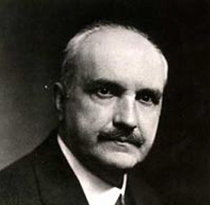
George Santayana
(biographical info at bottom of page) |
|
|
| |
|
Those
who cannot remember the past are doomed to relive it. |
| |
|
A
buoyant and full-blooded soul has quick senses and
miscellaneous
sympathies: it changes with the changing world; and when not
too
much starved or thwarted by circumstances, it finds all things
vivid
and comic. Life is free play fundamentally and would like to
be free
play altogether.
Progress, far
from consisting in change, depends on retentiveness. When change
is absolute there remains no being to improve and no direction is
set for possible improvement: and when experience is not retained,
as among savages, infancy is perpetual. Those who cannot remember
the past are condemned to repeat it. In the first stage of life
the mind is frivolous and easily distracted; it misses progress by
failing in consecutiveness and persistence. This is the condition
of children and barbarians, in which instinct has learned nothing
from experience.
It
takes patience to appreciate domestic bliss; volatile spirits
prefer unhappiness.
|

|
| |
|
The world is not respectable;
it is mortal, tormented,
confused, deluded forever; but it is shot through with
beauty, with love, with glints of courage and laughter;
and in these, the spirit blooms timidly, and struggles
to the light amid the thorns.
|
| |
|
A string of
excited, fugitive, miscellaneous pleasures is not happiness;
happiness resides in imaginative reflection and judgment,
when the
picture of one’s life, or of human life, as it truly has
been or is,
satisfies the will, and is gladly accepted.
|
| |
|
To
feel beauty is a better thing than to understand how we come to
feel it. To have imagination and taste, to love the best, to be carried by
the
contemplation of nature to a vivid faith in the ideal, all this is
more,
a great deal more, than any science can hope to be.
|
|
| |
|
Never build your emotional life on the
weaknesses of others. |
| |
|
|
|
quotations
- contents
-
welcome
page
- obstacles
- weblog
the
people behind the words
- our
current e-zine
- articles
and excerpts
Daily
Meditations, Year One - Year
Two - Year Three - Year
Four
Simple
and Profound website
Sign up for your free email daily
spiritual or general quotation
Sign
up for your free email daily meditation |
| |
|
People
become superstitious, not because they have too much
imagination, but because they are not aware that they have any. |
| |
|
What
is the part of wisdom? To dream with one eye open; to be
detached from the world without being hostile to it; to welcome
fugitive beauties and pity fugitive sufferings, without forgetting
for a moment how fugitive they are. |
| |
|
The
Difficult is that which can be done immediately;
the Impossible that which takes a little longer. |
| |
|

|
| |
|
Born Jorge Agustín
Nicolás Ruiz de Santayana, he spent his early childhood in Ávila,
Spain. His father was a diplomat, painter, and minor
intellectual. His mother was the daughter of a Spanish
official in the Philippine Islands. Jorge was the only child
of his mother's second marriage. She was the widow of George
Sturgis, a Boston merchant by whom she had five children, two of
whom died in infancy. She lived in Boston following her
husband's death in 1857, but in 1861 went with her three surviving
Sturgis children to live in Madrid. There she again
encountered Agustin Santayana, an old friend from her years in the
Philippines and married him in 1862. The family lived in
Madrid and Avila until 1869 when Santayana's mother returned to
Boston with her three Sturgis children, leaving Jorge, then five,
with his father in Spain. Jorge and his father followed her in
1872, but his father, not finding Boston to his liking, soon
returned alone to Ávila, where he remained for the rest of his
life. Jorge did not see his father again until summer
vacations while he was a student at Harvard. Hence from the
time he was five, Jorge's parents lived apart. Sometime during
this period Jorge americanized his name to George, its English
equivalent.
He attended Boston
Latin School and Harvard University, studying under William James
and Josiah Royce, whose colleague he subsequently became. After
graduating from Harvard in 1886, he studied for two years in Berlin,
then returned to Harvard to write a thesis on Rudolf Hermann Lotze
and teach philosophy, thus becoming part of the Golden Age of
Harvard philosophy. Some of his Harvard students became famous
in their own right, including T. S. Eliot, Gertrude Stein, Wallace
Stevens, Walter Lippmann, and Harry Austryn Wolfson.
In 1912, an
inheritance from his mother allowed him to retire from Harvard and
spend the rest of his life in Europe. After some years in
Paris and Oxford, he began to winter in Rome starting in 1920,
eventually living there year-round until his death in 1952. During
his 40 years in Europe, he wrote 19 books and declined several
prestigious academic positions. Most of his friends and
correspondents were Americans, including his valuable assistant and
eventual literary executor, Daniel Cory. The aged Santayana
was comfortable, in part because his 1935 novelized memoir, The
Last Puritan, sold well. In turn, he assisted financially
a number of writers including Bertrand Russell, with whom he was in
fundamental disagreement, philosophically and politically.
Santayana never married.
from Wikipedia
|
| |
|
|
| |
|

|
We
have some
inspiring and motivational books that may interest you. Our main way of supporting this site is
through the sale of books, either physical copies
or digital copies for your Amazon Kindle (including the
online reader). All of the money that we earn
through them comes back to the site
in one way or another. Just click on the picture
to the left to visit our page of books, both fiction and
non-fiction! |
|
| |
|
|
|