|
More
from and about
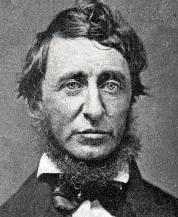
Henry David Thoreau
(biographical info at bottom of page) |
|
|
| |
|
However
mean your life is, meet it and live it: do not shun it
and call it hard names. Cultivate poverty like a garden herb,
like sage. Do not trouble yourself much to get new things,
whether clothes or friends. Things do not change, we change.
Sell your clothes and keep your thoughts.
God will see that you do want society. |
| |
|
I
learned this, at least, by my experiment: that if one advances
confidently in the direction of his or her dreams, and endeavors
to live the life which he or she has imagined, one will meet with
a success unexpected in common hours.
|

|
| |
|
I went to the woods because I
wished to live deliberately,
to front only the essential facts of life, and see if I
could not learn what it had to teach, and not, when I came
to die, discover that I had not lived. I did not wish to
live what was not life, living is so dear; nor did I wish
to practice resignation, unless it was quite necessary. I
wanted to live deep and suck out all the marrow of life, to
live so sturdily and Spartan-like as to put to rout all that
was not life, to cut a broad swath and shave close, to drive
life into a corner, and reduce it to its lowest terms.
|
| |
|
If
we respected only what is inevitable and has a right to be, music and poetry would resound along the streets. When we are unhurried and
wise, we perceive that only great and worthy things have any permanent
and absolute existence, that petty fears and petty pleasures are but the
shadow of the reality. This is always exhilarating and
sublime. By closing the eyes and slumbering, and consenting to be
deceived by shows, men establish and confirm their daily life of routine
and habit everywhere, which still is built on purely illusory
foundations. Children, who play life, discern its true law and
relations more clearly than men, who fail to live it worthily, but who
think they are wiser by experience, that is, by failure.
|
| |
|
We
must learn to reawaken and keep ourselves awake, not by mechanical
aids,
but by an infinite expectation of the dawn, which does not forsake
us even in
our soundest sleep. I know of no more encouraging fact than the
unquestionable
ability of people to elevate their lives by a conscious endeavour.
It is something
to be able to paint a particular picture, or to carve a statue,
and so to make a
few objects beautiful; but it is far more glorious to carve and
paint the very
atmosphere and medium through which we look, which morally we can
do. To
affect the quality of the day, that is the highest of arts.
|
|
| |
|
As a single footstep will not make a path on the
earth, so a single thought
will not make a pathway in the mind. To make a deep physical path,
we
walk again and again. To make a deep mental path, we must think
over
and over the kind of thoughts we wish to dominate our lives. |
| |
|

|
|
quotations
- contents
-
welcome
page
- obstacles
- weblog
the
people behind the words
- our
current e-zine
- articles
and excerpts
Daily
Meditations, Year One - Year
Two - Year Three - Year
Four
Simple
and Profound website
Sign up for your free email daily
spiritual or general quotation
Sign
up for your free email daily meditation |
| |
|
Go
confidently in the direction of your dreams. Live the life
you've imagined. |
| |
|
As
you simplify your life, the laws of the universe will be simpler;
solitude will not be solitude, poverty will not be poverty, nor
weakness weakness. |
| |
|
We
must walk consciously only part way toward our goal
and then leap in the dark to our success. |
| |
|
If we do not
keep pace with our companions, perhaps it is because
we
hear a different drummer. Let us step to the music
we hear,
however measured or far away.
|
| |
|

|
| |
| American
author and naturalist, born in Concord, Mass., and graduated from
Harvard, 1837. Thoreau is considered one of the most
influential figures in American thought and literature. A
supreme individualist, he championed the human spirit against
materialism and social conformity. His most famous book, Walden
(1854), is an eloquent account of his experiment in near-solitary
living in close harmony with nature; it is also an expression of
his transcendentalist philosophy.
Thoreau grew up
in Concord and attended Harvard, where he was known as a serious
though unconventional scholar. During his Harvard years he
was exposed to the writings of Ralph Waldo Emerson, who later
became his chief mentor and friend. After graduation,
Thoreau worked for a time in his father's pencil shop and taught
at a grammar school, but in 1841 he was invited to live in the
Emerson household, where he remained intermittently until
1843. He served as handyman and assistant to Emerson,
helping to edit and contributing poetry and prose to the
transcendentalist magazine, The Dial.
In 1845 Thoreau
built himself a small cabin on the shore of Walden Pond, near
Concord; there he remained for more than two years, "living
deep and sucking out all the marrow of life." Wishing
to lead a life free of materialistic pursuits, he supported
himself by growing vegetables and by surveying and doing odd jobs
in the nearby village. He devoted most of his time to
observing nature, reading, and writing, and he kept a detailed
journal of his observations, activities, and thoughts. It
was from this journal that he later distilled his masterpiece, Walden.
The journal, begun in 1837, was also the source of his first book,
A Week on the Concord and Merrimack Rivers (1849), as well
as of his posthumously published Excursions (1863), The
Maine Woods (1864), Cape Cod (1865), and A Yankee in
Canada (1866).
One of Thoreau's
most important works, the essay "Civil Disobedience"
(1849), grew out of an overnight stay in prison as a result of his
conscientious refusal to pay a poll tax that supported the Mexican
War, which to Thoreau represented an effort to extend
slavery. Thoreau's advocacy of civil disobedience as a means
for the individual to protest those actions of his government that
he considers unjust has had a wide-ranging impact–on the British
Labour movement, the passive resistance independence movement led
by Gandhi in India, and the nonviolent civil-rights movement led
by Martin Luther King in the United States.
Thoreau is also
significant as a naturalist who emphasized the dynamic ecology of
the natural world. Above all, Thoreau's quiet, one-man
revolution in living at Walden has become a symbol of the willed
integrity of human beings, their inner freedom, and their ability
to build their own lives. Thoreau's writings, including his
journals, were published in 20 volumes in 1906.
|
| |
|
|
| |
|

|
We
have some
inspiring and motivational books that may interest you. Our main way of supporting this site is
through the sale of books, either physical copies
or digital copies for your Amazon Kindle (including the
online reader). All of the money that we earn
through them comes back to the site
in one way or another. Just click on the picture
to the left to visit our page of books, both fiction and
non-fiction! |
|
| |
|

|
|