|
more
zen
|
Zen
Sayings |
If
you try to aim for it,
you are turning away from it. |
|
|
|
|
No snowflake ever falls in the wrong place. |
|
| |
|
Water
which is too pure has no fish.
Ts’ai Ken T’an |
| |
|
The
quieter you become,
the more you are able to hear. |
| |
|
Sitting
peacefully doing nothing
Spring comes
and the grass grows all by itself. |
| |
|
We
shape clay into a pot, but it is the emptiness
inside
that holds whatever we want.
Lao
Tzu
|
|
| |
|

|
| |
|
Two
monks were once traveling together down a muddy road.
A heavy rain was falling. Coming around the bend,
they met a lovely girl in a silk kimono and sash,
unable to cross the intersection.
"Come
on, girl," said the first monk. Lifting her
in his arms, he carried her over the mud.
The
second monk did not speak again until that night
when they reached a lodging temple. Then he no longer
could restrain himself. "We monks don't go near
females,"
he said. "It is dangerous. Why did you do
that?"
"I
left the girl there," the first monk said.
"Are you still carrying her?"
|
| |
Te-shan
was sitting outside doing zazen. Lung-t'an
asked him why he didn't go back home. Te-shan answered,
"Because it is dark." Lung-t'an then lit a
candle and handed
it to him. As Te-shan was about to take it, Lung-t'an
blew it out.
Te-shan had a sudden realization, and bowed. |
| |
|
Talking about
Zen all the time is like
looking for fish tracks in a dry riverbed.
Wu-Tzu
|
| |
|
One
day Chuang-tzu and a friend
were walking along a riverbank.
"How
delightfully the fishes are
enjoying themselves in the water!"
Chuang-tzu exclaimed.
"You
are not a fish," his friend said.
"How do you know whether or not
the fishes are enjoying themselves?"
"You
are not me," Chuang-tzu said.
"How do you know that I do not know
that the fishes are enjoying themselves?"
|
| |
|
|
| |
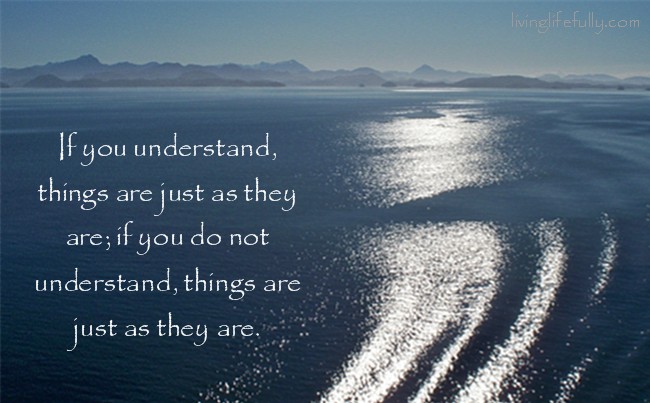
If you understand, things are just as they are;
if you do not understand, things are just as they are. |
| |
|
Learning
Zen is a phenomenon of gold and dung.
Before you understand it, it's like gold; after you
understand
it, it's like dung.
Zen
master
|
| |
|
Zen
is not some kind of excitement but concentration on
our usual everyday routine.
Shunryu
Suzuki
|
From
the pine tree,
learn of the pine tree,
and from the bamboo,
learn of the bamboo. |
|
| |
|
After
winning several archery contests, the young and rather
boastful champion
challenged a Zen master who was renowned for his skill as an
archer.
The young man demonstrated remarkable technical proficiency
when he
hit a distant bull's eye on his first try, and then split that
arrow with his
second shot. "There," he said to the old man,
"see if you can match that!"
Undisturbed,
the master did not draw his bow, but rather motioned
for the young archer to follow him up the mountain.
Curious about
the old fellow's intentions, the champion followed him high
into the
mountain until they reached a deep chasm spanned by a rather
flimsy
and shaky log. Calmly stepping out onto the middle of
the unsteady
and certainly perilous bridge, the old master picked a far
away tree
as a target, drew his bow, and fired a clean, direct hit.
"Now
it is your turn," he said as he gracefully stepped back
onto the
safe ground. Staring with terror into the seemingly
bottomless
and beckoning abyss, the young man could not force himself to
step
out onto the log, no less shoot at a target. "You
have much skill with
your bow," the master said, sensing his challenger's
predicament,
"but you have little skill with the mind that lets loose
the shot." |
| |
|
|
|
quotations
- contents
-
welcome
page
-
obstacles
our
current e-zine
-
the
people behind the words
-
articles
and excerpts
Daily
Meditations, Year One - Year
Two - Year Three
- Year Four
Sign up
for your free daily spiritual or general quotation ~ ~ Sign
up for your free daily meditation
|
| |
Two
monks were washing their bowls in the river when they
noticed a scorpion that was drowning. One monk
immediately
scooped it up and set it upon the bank. In the process
he was
stung. He went back to washing his bowl and again the
scorpion
fell in. The monk saved the scorpion and was again
stung. The
other monk asked him, "Friend, why do you continue to
save the
scorpion when you know its nature is to sting?"
"Because,"
the monk replied, "to save it is my nature." |
| |
|
Before enlightenment, I chopped wood and
carried water.
After enlightenment, I chopped wood and carried water. |
| |
|
|
| |
|
Consider
the trees which allow the birds to perch and fly away
without either inviting them to stay or desiring them
never to depart. If your heart can be like this,
you will be near to the way. |
| |
|
Hogen,
a Chinese Zen teacher, lived alone in a small temple
in the country. One day four traveling monks appeared and
asked if they might make a fire in his yard to warm
themselves.
While
they were building the fire, Hogen heard them arguing
about subjectivity and objectivity. He joined them and said:
"There is a big stone. Do you consider it to be inside or
outside your mind?"
One of
the monks replied: "From the Buddhist viewpoint
everything
is an objectification of mind, so I would say that the stone
is inside my mind."
"Your
head must feel very heavy," observed Hogen,
"if you are carrying around a stone like that in your
mind." |
| |
|
|
|
more
zen
|
|
Yamaoka
Tesshu, as a young student of Zen, visited one
master
after another. He called upon Dokuon of Shokoku.
Desiring
to show his attainment, he said: "The mind,
Buddha,
and sentient beings, after all, do not exist.
The true nature of
phenomena is emptiness. There is no
realization, no delusion, no
sage, no mediocrity.
There is no giving and nothing to be
received."
Dokuon,
who was smoking quietly, said nothing. Suddenly he
whacked Yamaoka with his bamboo pipe. This made the
youth
quite angry.
"If
nothing exists," inquired Dokuon, "where did
this anger come from?"
|
| |
|
|
| |
When
Banzan was walking through a market he overheard
a conversation between a butcher and his customer.
"Give me the best
piece of meat you have," said the customer.
"Everything in my
shop is the best," replied the butcher. "You
cannot
find here any piece of meat that is not the best."
At these words Banzan
became enlightened. |
| |
| True
spiritual practice is not founded on attainment or on
the miraculous, but on seeing life itself as a true
miracle. In the words of a Zen master,
My magical power and miraculous gift:
Drawing water and chopping wood. |
|
| |
|
|
| |
|
No seed ever sees the flower. |
| |
If
your mind is empty, it is always ready for anything;
it is open to everything. In the beginner's mind there
are
many possibilities, in the expert's mind there are few.
Shunryu
Suzuki-Roshi |
| |
|
In a small hut, Hakuin lived a quiet life
devoted to monastic purity.
When the young unmarried daughter of the village grocer
became pregnant, she named Hakuin as the father. Her
outraged
parents went to Hakuin and charged him with the deed.
Hakuin simply said, "Is that so?"
When the child was born, once again the
parents came to Hakuin.
They handed him the baby and demanded he take responsibility
for raising it. Hakuin said, "Is that so?" and
took the baby in his arms.
Dutifully he began to look after the infant.
A year later, the young woman could bear it
no longer. She confessed
that the real father was a young man who worked in the
nearby fishmarket. The parents went to Hakuin once more,
this time making deep apologies, and asked him to return the
child.
Hakuin said only, "Is that so?" and gave the baby
back to them.
traditional Zen Buddhist story
|
| |
The
fish trap exists because of the fish. Once you've
gotten the fish
you can forget the trap. The rabbit snare exists
because of the rabbit.
Once you've gotten the rabbit, you can forget the
snare. Words exist
because of their meaning. Once you've got the meaning,
you can forget
the words. Where can I find someone who has forgotten words
so I can talk with him or her?
Chuang
Tzu
|
| |
|

|
We
have some
inspiring and motivational books that may interest you. Our main way of supporting this site is
through the sale of books, either physical copies
or digital copies for your Amazon Kindle (including the
online reader). All of the money that we earn
through them comes back to the site
in one way or another. Just click on the picture
to the left to visit our page of books, both fiction and
non-fiction! |
|
| |
|
You
must have been warned against letting the golden hours slip
by;
but some of them are golden only because we let them slip by.
James
M. Barrie
|
| |
|
|
|
quotations
- contents
-
welcome
page
-
obstacles
our
current e-zine
-
the
people behind the words
-
articles
and excerpts
Daily
Meditations, Year One - Year
Two - Year Three
- Year Four
Sign up
for your free daily spiritual or general quotation ~ ~ Sign
up for your free daily meditation
|
| |
The
story is told of one of the great patriarchs of the
Zen tradition. The tradition was that the begging bowl and robe are
passed as the
symbol of the passing of the heritage from one abbot
to another. This particular abbot did not have anybody
in his lineage that he thought was worthy of
inheriting his bowl and his mantle. So he decided upon
a test. He announced that whoever could come up with
the most appropriate couplet would be the inheritor of
the bowl. On the wall next to the dining hall poems
began to appear. One of the poems went like this:
The Dharma wipes the dust from the mirror.
The mind reflects Buddha nature.
Another one said:
Meditation cleanses the mirror
That the mind may see the teaching.
Another wrote up there—and this was a little closer:
If the mind is dusty, it matters not
How clear the mirror.
Finally, the cook, who had never sat in meditation,
who had never visited the Master, wrote his own
couplet on the wall, in response to those earlier
poems. The couplet went like this:
No Mind. No Mirror.
Where does all this talk of dirt come from?
He got the mantle and the bowl.
-related by Mike Young |
|
|
more
zen
|
The
ultimate standpoint of Zen is that we have been led astray
through ignorance
to find a split in our own being, that there was from the very
beginning no need for
a struggle between the finite and the infinite, that the peace
we are seeking so
eagerly after has been there all the time.
D.T. Suzuki |
|
|
|
Zen is about an active life, an involved life.
When we know our minds
well and the emotions that our thinking creates, we tend to see better
what our lives are about and what needs to be done, which is generally
just the next task under our nose. Zen is about a life of action, not a life
of passively doing nothing. But our actions must be based on reality.
When our actions are based on our false thought systems (which are
based on our conditioning), they are poorly based. When we have seen
through the thought systems we can see what needs to be done.
Charlotte Joko Beck
Everyday Zen: Love and Work
|
|
|
|
Trying
to explain Zen is like trying to catch wind in a box; the
moment
you close the lid it ceases to be wind and in time becomes
stagnant air.
Alan Watts
The Meaning of Happiness
|
|
|
|

|
|
|