|
More
from and about
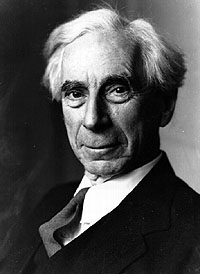
Bertrand Russell
(biographical info at bottom of page) |
|
|
| |
|
Boredom
is therefore a vital problem for the moralist,
since at least half the sins of mankind are caused by the fear of
it. |
| |
|
One
should as a rule respect public opinion in so far as is
necessary to avoid starvation and to keep out of prison,
but anything that goes beyond this is voluntary submission
to an unnecessary tyranny, and is likely to interfere with
happiness in all kinds of ways.
People fear
thought as they fear nothing else on earth -- more than ruin, more
even than death. Thought is subversive and revolutionary,
destructive and terrible, thought is merciless to privilege,
established institutions, and comfortable habits; thought is
anarchic and lawless, indifferent to authority, careless of the
well-tried wisdom of the ages. Thought looks into the pit of hell
and is not afraid. . . Thought is great and swift and free, the
light of the world, and the chief glory of humans.
It has been said
that the human being is a rational animal. All my life I have been
searching for evidence which could support this.
|

|
| |
|
If there were in the world
today any large number
of people who desired their own happiness more than
they desired the unhappiness of others, we could
have paradise in a few years.
|
| |
|
If throughout
your life you abstain from murder, theft, fornication,
perjury, blasphemy, and disrespect toward your parents,
church,
and your king, you are conventionally held to deserve moral
admiration even if you have never done a single kind,
generous
or useful action. This very inadequate notion of virtue is
an
outcome of taboo morality, and has done untold harm.
|
| |
|
When
you want to teach children to think, you begin by treating them
seriously when they are little, giving them responsibilities,
talking to
them candidly, providing privacy and solitude for them, and making
them readers and thinkers of significant thoughts from the
beginning. That’s if you want to teach them to think.
|
|
| |
|
Anything you're good at contributes to
happiness. |
| |
|

|
|
welcome
page
- contents
-
gallery
-
obstacles
-
quotations
- the
people behind the words
our
current e-zine
-
articles
and excerpts
- Daily
Meditations, Year
Two - Year Three
Sign up
for your free daily spiritual or general quotation ~ ~ Sign
up for your free daily meditation |
| |
|
One
of the symptoms of an approaching nervous breakdown
is the belief that one’s work is terribly important. |
| |
|
I
think we ought always to entertain our opinions with
some measure of doubt. I shouldn't wish people
dogmatically to believe any philosophy, not even mine. |
| |
|
It
is the preoccupation with possessions, more than anything
else that prevents us from living freely and nobly. |
| |
|

|
| |
| Bertrand
Arthur William Russell (b.1872 - d.1970) was a British
philosopher, logician, essayist, and social critic, best known for
his work in mathematical logic and analytic philosophy. His
most influential contributions include his defense of logicism
(the view that mathematics is in some important sense reducible to
logic), and his theories of definite descriptions and logical
atomism. Along with G.E. Moore, Russell is generally
recognized as one of the founders of analytic philosophy.
Along with Kurt Gödel, he is also regularly credited with being
one of the two most important logicians of the twentieth century.
Over the course
of his long career, Russell made significant contributions, not
just to logic and philosophy, but to a broad range of other
subjects including education, history, political theory and
religious studies. In addition, many of his writings on a
wide variety of topics in both the sciences and the humanities
have influenced generations of general readers. After a life
marked by controversy (including dismissals from both Trinity
College, Cambridge, and City College, New York), Russell was
awarded the Order of Merit in 1949 and the Nobel Prize for
Literature in 1950. Also noted for his many spirited
anti-war and anti-nuclear protests, Russell remained a prominent
public figure until his death at the age of 97.
|
| |
|
|
| |
|

|
We
have some
inspiring and motivational books that may interest you. Our main way of supporting this site is
through the sale of books, either physical copies
or digital copies for your Amazon Kindle (including the
online reader). All of the money that we earn
through them comes back to the site
in one way or another. Just click on the picture
to the left to visit our page of books, both fiction and
non-fiction! |
|
| |
|

|
|