|
More
from and about
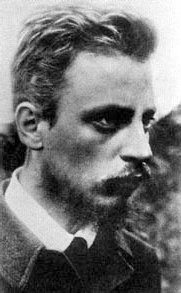
Rainer Maria Rilke
(biographical info at bottom of page) |
|
|
| |
|
There
are no classes in life for beginners;
right away you are always asked to deal with what is most difficult. |
| |
|
Surely
all art is the result of one's having been in danger, of having
gone through an experience all the way to the end, where no one
can go any further. The further one goes, the more private,
the more personal, the more singular an experience becomes,
and the thing one is making is, finally, the necessary, irrepressible,
and, as nearly as possible, definitive utterance of this singularity.
|
|
| |
|
What is
required of us is that we love the difficult and learn
to deal with it. In the difficult are the friendly forces, the
hands
that work on us. Right in the difficult we must have our joys,
our happiness, our dreams: there against the depth of this
background, they stand out, there for the first time
we see how beautiful they are.
|
| |
The longer I live, the more necessary it seems to me to
endure,
to copy the whole dictation of existence to the end, for it might
be that only the last sentence contains that small, perhaps
inconspicuous
word through which all laboriously learned and not understood
orients itself toward glorious sense.
Be patient
toward all that is unsolved in your heart and try to love
the questions themselves, like locked rooms and like books
that are now written in a very foreign tongue. Do not now
seek the answers, which cannot be given you because you
would not be able to live them. And the point is, to live
everything. Live the questions now. Perhaps you will then
gradually, without noticing it, live along some distant day
into the answer.
|
| |
|
I hold
this to be the highest task of a bond between two people: that
each should stand guard over the solitude of the other. For, if it
lies in
the nature of indifference and of the crowd to recognize no solitude,
then love and friendship are there for the purpose of continually
providing
the opportunity for solitude. And only those are the true sharings
which rhythmically interrupt periods of deep isolation.
|
|
| |
|
But
now that so much is changing, is it not up to us
to change ourselves? Could we not develop ourselves a little,
and slowly take upon ourselves our share of work in love, little by
little? |
| |
|

|
|
quotations
- contents
-
welcome
page
- obstacles
- weblog
the
people behind the words
- our
current e-zine
- articles
and excerpts
Daily
Meditations, Year One - Year
Two - Year Three - Year
Four
Simple
and Profound website
Sign up for your free email daily
spiritual or general quotation
Sign
up for your free email daily meditation |
| |
|
Believe that with your feelings and
your work you are
taking part in the greatest; the more strongly you cultivate this
belief,
the more will reality and the world go forth from it. |
| |
|
For as yet I did not
understand fame, that public destruction
of one in the process of becoming, into whose building-ground
the mob breaks, displacing his stones. |
| |
|
Oh,
how I believe in it, in life. Not that which makes up our time,
but that
other, the life of little things, the life of animals and of the great
plains. |
| |
|

|
| |
Rainer
Maria Rilke was born in Prague on December 4, 1875, the only
child of an unhappy marriage. Rilke's childhood was also unhappy;
his
parents placed him in military school with the desire that he
become an officer, a position Rilke was not inclined to hold. With the help
of
his uncle, who realized that Rilke was a highly gifted child,
Rilke left
the military academy and entered a German preparatory school.
By
the
time he enrolled in Charles University in Prague in 1895, he knew
that
he would pursue a literary career: he had already published his
first
volume of poetry, Leben und Lieder, the previous year.
At the turn
of
1895-96, Rilke published his second collection, Larenopfer
(Sacrifice to
the Lares). A third collection, Traumgekrönt (Dream-Crowned)
followed in
1896. That same year, Rilke decided to leave the university for
Munich,
Germany, and later made his first trip to Italy.
In 1897, Rilke went to Russia, a trip that would prove to be a
milestone in Rilke's life, and which marked the true beginning of
his
early serious works. While there the young poet met Tolstoy, whose
influence is seen in Das Buch vom lieben Gott und anderes (Stories
of
God), and Leonid Pasternak, the nine-year-old Boris's father.
At
Worpswede, where Rilke lived for a time, he met and married Clara
Westhoff, who had been a pupil of Rodin. In 1902 he became the
friend,
and for a time the secretary, of Rodin, and it was during his
twelve-year Paris residence that Rilke enjoyed his greatest poetic
activity. His first great work, Das Stunden Buch (The Book of
Hours),
appeared in 1906, followed in 1907 by Neue Gedichte (New Poems)
and Die
Aufzeichnungen des Malte Laurids Brigge (The Notebooks of Malte
Laurids Brigge). Rilke would continue to travel throughout his lifetime;
to
Italy, Spain and Egypt among many other places, but Paris would
serve as
the geographic center of his life, where he first began to develop
a new
style of lyrical poetry, influenced by the visual arts.
When World War I broke out, Rilke was obliged to leave France and
during the war he lived in Munich. In 1919 he went to Switzerland
where
he spent the last years of his life. It was here that he wrote his
last
two works, the Duino Elegies (1923) and the Sonnets to Orpheus
(1923). He died of leukemia on December 29, 1926. At the time of his death
his
work was intensely admired by many leading European artists, but
was
almost unknown to the general reading public. His reputation has
grown
steadily since his death, and he has come to be universally
regarded as
a master of verse.
|
| |
|
|
| |
|
|
We
have some
inspiring and motivational books that may interest you. Our main way of supporting this site is
through the sale of books, either physical copies
or digital copies for your Amazon Kindle (including the
online reader). All of the money that we earn
through them comes back to the site
in one way or another. Just click on the picture
to the left to visit our page of books, both fiction and
non-fiction! |
|
| |
|

|
|