|
More
on and from
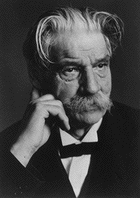
Albert
Schweitzer |
|
|
| |
Affirmation
of life is the spiritual act by which people cease
to
live
unreflectively and begin to devote themselves to
their lives
with reverence in order to raise
them to their
true value. To
affirm
life is to deepen, to make more inward, and to
exalt the will-to-live.
|
| |
|
A
great secret of success is to go through life
as a person who never gets used up.
|

|
| |
It
is not enough merely to exist. It's not enough to say, "I'm
earning
enough to support my family. I do my work well. I'm a good father,
husband, mother, wife, churchgoer." That's all very
well. But you
must do something more. Seek always to do some good, somewhere.
Every person has to seek in his or her own way to realize his or her
true worth. You must give some time to your fellow human beings.
For remember, you don't live in a world all your own. Your brothers and sisters are here, too.
Affirmation
of life is the spiritual act by which people cease
to live
unreflectively and begin to devote themselves to
their lives with reverence in order to raise
them to their
true value. To
affirm life is to deepen, to make more inward,
and to
exalt the will-to-live.
|
| |
|
Those
who thank God much are the truly wealthy. So our inner happiness depends not on what
we experience but on the degree of our gratitude
to God, whatever the experience. Your life
is something opaque, not transparent, as long as
you look at it in an ordinary human way. But if
you hold it up against the light of God's goodness,
it shines and turns transparent, radiant and bright. And then you ask yourself in amazement: Is this really my own life I see before me?
|
| |
|
Anyone
who proposes to do good must not expect people
to roll stones out of the way, but must accept his or her
lot calmly, even if they roll a few stones upon it.
Compassion,
in which all ethics must take root,
can only attain its
full breadth and depth
if it embraces all living creatures and
does not limit itself to humankind.
|
|
| |
|
One
can do only what one can do. But if someone does that each day
he or she can sleep at night and do it again the next day. |
| |
|

|
|
quotations
- contents
-
welcome
page
- obstacles
- weblog
the
people behind the words
- our
current e-zine
- articles
and excerpts
Daily
Meditations, Year One - Year
Two - Year Three - Year
Four
Simple
and Profound website
Sign up for your free email daily
spiritual or general quotation
Sign
up for your free email daily meditation |
| |
|
Constant
kindness can accomplish much. As the sun
makes ice melt, kindness causes misunderstanding,
mistrust, and hostility to evaporate. |
| |
|
Everything
deep is also simple and can be reproduced
simply as long as its reference to the whole truth is maintained.
But what matters is not what is witty but what is true. |
| |
Impart
as much as you can of your spiritual being
to those who are on the road with you, and accept
as something precious what comes back to you from them. |
| |
|

|
| |
|
When
in the spring the withered gray of the pastures
gives place to green, this is due to the millions
of young shoots which sprout up freshly from the old roots.
In like manner the revival of thought which is essential
for our time can only come through a transformation
of the opinions and ideals of the many brought about
by individual and universal reflection about
the meaning of life and of the world. |
| |
The
willow which bends to the tempest, often escapes
better than the oak which resists it; and so in great calamities,
it sometimes happens that light and frivolous spirits recover
their elasticity and presence of mind sooner than those of a loftier
character. |
| |
|
Everything
deep is also simple and can be reproduced
simply as long as its reference to the whole truth is maintained.
But what matters is not what is witty but what is true. |
| |
|
What we seem to
forget is that yes, the sun will continue to rise
and set and the moon will continue to move across the skies, but
humankind can create a situation in which the sun and the moon
can look down upon an Earth that has been stripped of all life. |
| |
Albert
Schweitzer (January 14, 1875-September 4, 1965) was born into an
Alsatian family which for generations had been devoted to
religion,
music, and education. His father and maternal grandfather were
ministers; both of his grandfathers were talented organists; many
of his
relatives were persons of scholarly attainments.
Schweitzer entered into his intensive theological studies in 1893
at
the University of Strasbourg where he obtained a doctorate in
philosophy in 1899, with a dissertation on the religious
philosophy of Kant, and received his licentiate in theology in
1900. He began preaching at St. Nicholas Church in Strasbourg in
1899; he served in various high ranking administrative posts from
1901 to 1912 in the Theological College of St.Thomas, the college
he had attended at the University of Strasbourg. In 1906 he
published The Quest of the Historical Jesus, a book on which much
of his fame as a theological scholar rests.
Meanwhile he continued with a distinguished musical career
initiated at
an early age with piano and organ lessons. Only nine when he first
performed in his father's church, he was, from his young manhood
to his
middle eighties, recognized as a concert organist, internationally
known. From his professional engagements he earned funds for his
education, particularly his later medical schooling, and for his
African
hospital. Musicologist as well as performer, Schweitzer wrote a
biography of Bach in 1905 in French, published a book on organ
building
and playing in 1906, and rewrote the Bach book in German in 1908.
Having decided to go to Africa as a medical missionary rather than
as a
pastor, Schweitzer in 1905 began the study of medicine at the
University of Strasbourg. In 1913, having obtained his M.D.
degree, he founded his hospital at Lambaréné in French
Equatorial Africa, but in 1917 he and his wife were sent to a
French internment camp as prisoners of war. Released in
1918, Schweitzer spent the next six years in Europe, preaching in
his old church, giving lectures and concerts, taking medical
courses, writing On the Edge of the Primeval Forest, The Decay and
Restoration of Civilization, Civilization and Ethics, and
Christianity and the Religions of the World.
Schweitzer returned to Lambaréné in 1924 and except for
relatively
short periods of time, spent the remainder of his life there.
With
the
funds earned from his own royalties and personal appearance fees
and
with those donated from all parts of the world, he expanded the
hospital
to seventy buildings which by the early 1960's could take care of
over
500 patients in residence at any one time.
At Lambaréné, Schweitzer was doctor and surgeon in the hospital,
pastor of a congregation, administrator of a village,
superintendent of
buildings and grounds, writer of scholarly books, commentator on
contemporary history, musician, host to countless visitors. The
honors
he received were numerous, including the Goethe Prize of Frankfurt
and
honorary doctorates from many universities emphasizing one or
another of his achievements. The Nobel Peace Prize for 1952,
having been withheld in that year, was given to him on December
10, 1953. With the $33,000 prize money, he started the leprosarium
at Lambaréné.
Albert Schweitzer died on September 4, 1965, and was buried at
Lambaréné.
(adapted from Wikipedia)
| A
passage from Alan Loy McGinnins' Bringing Out the Best
in People:
In 1875,
a sickly child was born in Upper Alsace who was slow to
read and write and was a poor scholar. But as he
grew up he made himself master subjects that were
particularly difficult, such as Hebrew. In music, he
turned out to be a genuine prodigy, playing the organ at
eight when his legs were scarcely long enough to reach the
pedals. At nine he substituted for the regular
organist in a church service.
His name
was Albert Schweitzer, and everyone knows how by early
manhood he had several professional lives proceeding
concurrently. At the University of Strasbourg he
earned his first Ph.D. in philosophy, then went on to win
doctorates in theology and music theory. By the time
he was 30, he had a flourishing career as a concert
organist and was publishing a stream of books. But
then he abruptly stopped his academic career in order to
study medicine and devote the rest of his life to being a
missionary. This had begun when by chance he read a
magazine article about the Congo. "While we are
preaching to these people about religion," the
article said, "they are suffering and dying before
our eyes from physical maladies."
Schweitzer
had received his calling, and he began to lay plans to go
to Africa. Friends protested: if the
aborigines of Africa needed help, let Schweitzer raise
money for their assistance. He certainly was not
called upon to wash lepers with his own hands.
There
will always be such people who try to tell us to be
realistic, people who seem to find it their calling to
attempt to flatten our dreams and diminish our
lives. But there will always be a few, thankfully,
who will encourage our ideals and gladly join us in our
goals. When Schweitzer fell in love with Helen
Bresslau, the daughter of a Jewish historian, he bluntly
proposed: "I am studying to be a doctor for the
people of Africa. Would you spend the rest of your
life with me--in the jungle?"
And she
answered, "I shall become a nurse. Then how
could you go without me?" And on Good Friday of
1913, the two of them left for French Equatorial
Africa. For more than 50 years he served there,
eventually to become a Nobel laureate and a legend.
|
|
| |
|
|
| |
|

|
We
have some
inspiring and motivational books that may interest you. Our main way of supporting this site is
through the sale of books, either physical copies
or digital copies for your Amazon Kindle (including the
online reader). All of the money that we earn
through them comes back to the site
in one way or another. Just click on the picture
to the left to visit our page of books, both fiction and
non-fiction! |
|
| |
|

|
|